
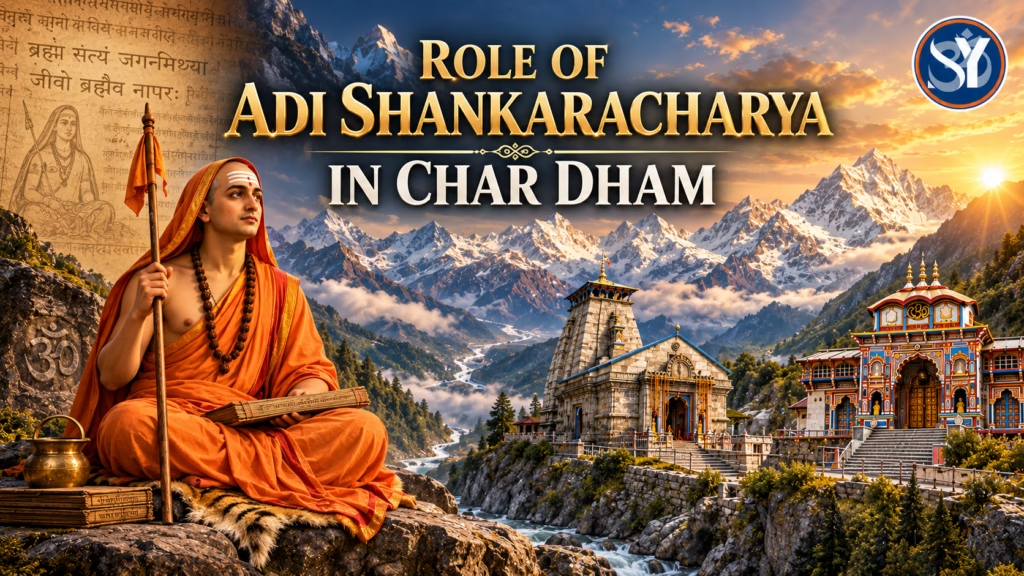
Role of Adi Shankaracharya in Char Dham-The Char Dham Yatra holds a special place in India’s spiritual and cultural heritage. In Uttarakhand, the sacred circuit connects Yamunotri, Gangotri, Kedarnath and Badrinath—four Himalayan shrines associated with Goddess Yamuna, Goddess Ganga, Lord Shiva and Lord Vishnu.
Although the religious importance of these places is rooted in ancient scriptures and mythology, Adi Shankaracharya is traditionally credited with helping revive, organise and connect several major pilgrimage centres during the early medieval period. His influence is particularly strong at Badrinath and Kedarnath.
Adi Shankaracharya travelled across India at a time when long-distance journeys were extremely difficult. He promoted the teachings of Advaita Vedanta, engaged with different schools of philosophy and strengthened sacred institutions across the country. His work helped transform pilgrimage into a force for spiritual education, cultural continuity and national unity.
For travellers undertaking a Luxury Chardham Yatra Package, understanding his contribution adds greater depth to the journey. The temples are not simply isolated religious sites; they are part of a vast spiritual network that has connected different communities and regions for centuries.
This article explores Adi Shankaracharya’s life, philosophy and role in the development of the Char Dham tradition while distinguishing documented history from religious belief.
Who Was Adi Shankaracharya?
Adi Shankaracharya was one of India’s most influential philosophers, spiritual teachers and religious reformers. He is traditionally believed to have been born in Kalady, in present-day Kerala, and to have lived during the eighth century CE, although scholars have proposed different dates for his lifetime.
According to traditional biographies, Shankara showed exceptional spiritual intelligence from childhood. He became a renunciate at a young age and studied under Govinda Bhagavatpada, who was himself a disciple in the lineage of Gaudapada.
Shankaracharya travelled widely across the Indian subcontinent, teaching, debating and visiting sacred sites. He wrote commentaries on foundational Hindu texts, including:
- The Upanishads
- The Bhagavad Gita
- The Brahma Sutras
His teachings became closely associated with Advaita Vedanta, the philosophy of non-duality.
Despite his short traditional lifespan of approximately 32 years, his influence on Indian philosophy, temple traditions and pilgrimage culture has endured for more than a millennium.
What Is Advaita Vedanta?
The term “Advaita” means “not two” or non-dual. Advaita Vedanta teaches that the ultimate reality, Brahman, is one and indivisible. The individual self, known as Atman, is not fundamentally separate from this absolute reality.
According to this philosophy, the experience of separation arises from ignorance. Spiritual knowledge removes that ignorance and leads a seeker towards liberation.
At first glance, this may appear different from temple worship and pilgrimage, where devotees worship particular forms of God. However, Shankaracharya did not necessarily reject devotional practices.
For most seekers, prayer, discipline, worship and pilgrimage can help purify the mind and prepare it for deeper spiritual understanding. Different deities and traditions may therefore serve as paths towards the same ultimate truth.
This inclusive approach helps explain how Shankaracharya could promote a non-dual philosophy while also strengthening temples dedicated to Shiva, Vishnu and other divine forms.
India’s Spiritual Landscape Before Shankaracharya
The sacred places now included in the Char Dham traditions were considered holy long before Adi Shankaracharya.
Badrikashram appears in ancient religious traditions as a place associated with Lord Vishnu and the sages Nara and Narayana. Kedarnath is linked with Lord Shiva, the Pandavas and the Panch Kedar narrative. Gangotri is connected with the descent of Goddess Ganga, while Yamunotri is associated with Goddess Yamuna and Sage Asit Muni.
Shankaracharya did not create the sacredness of these landscapes. Their religious importance had already developed through mythology, ascetic traditions, regional worship and the journeys of earlier pilgrims.
His contribution is better understood as revival, organisation and integration. Traditional accounts credit him with restoring neglected shrines, establishing systems of worship and connecting regional pilgrimage centres with a larger vision of Hindu spiritual unity.
Two Meanings of Char Dham
To understand Shankaracharya’s role correctly, it is important to distinguish between two related pilgrimage traditions.
The All-India Char Dham
The four major pilgrimage centres located in different parts of India are:
- Badrinath in the north
- Dwarka in the west
- Jagannath Puri in the east
- Rameswaram in the south
This national circuit is strongly associated with Adi Shankaracharya’s vision of connecting India’s sacred geography.
The Uttarakhand Char Dham

The four Himalayan shrines are:
- Yamunotri
- Gangotri
- Kedarnath
- Badrinath
This circuit is often called the Chota Char Dham or Himalayan Char Dham.
Shankaracharya’s direct traditional association is strongest with Badrinath and Kedarnath. His relationship with Yamunotri and Gangotri is broader and symbolic, connected with his support for Himalayan pilgrimage and the integration of different traditions.
It would be historically misleading to say with certainty that he personally constructed all four Uttarakhand temples in their present forms.
Adi Shankaracharya’s Role at Badrinath
Badrinath is the Char Dham shrine most closely connected with Adi Shankaracharya.
Located beside the Alaknanda River in Chamoli district, Badrinath is dedicated to Lord Vishnu in the form of Badri Narayan. The region was traditionally known as Badrikashram and had long been associated with meditation and penance.
Recovery of the Badri Narayan Idol
According to temple tradition, Adi Shankaracharya recovered the sacred black stone image of Lord Badri Narayan from Narad Kund.
He is believed to have installed the image in a cave near the Tapt Kund hot springs. In a later period, the Garhwal ruler moved the deity to the present temple.
The Badrinath-Kedarnath Temple Committee records the tradition that Shankaracharya recovered the Saligram stone image from Narad Kund and re-established it during the eighth century. Badrinath-Kedarnath Temple Committee
This event is considered one of his most important contributions to the Himalayan pilgrimage tradition.
Revival of Badrinath as a Pilgrimage Centre
Traditional accounts describe Badrinath as a shrine whose importance had declined or whose worship had become disrupted before Shankaracharya’s arrival.
By reinstalling the deity and strengthening the system of worship, he is believed to have revived Badrinath as a major Vaishnava pilgrimage centre.
Uttarakhand Tourism also associates the establishment of Badrinath Temple with Adi Shankaracharya in the eighth century. Uttarakhand Tourism
The building visible today has undergone several phases of construction, enlargement and restoration. Therefore, Shankaracharya’s role should not necessarily be interpreted as constructing every part of the present structure.
His greater contribution was spiritual and institutional: restoring the shrine’s religious importance and giving it a permanent place within India’s pilgrimage network.
Establishment of Jyotirmath
Adi Shankaracharya is traditionally associated with the establishment of Jyotirmath, now commonly called Joshimath.
Situated on the route to Badrinath, Jyotirmath became an important centre of learning, monastic life and spiritual administration. It is traditionally regarded as the northern seat among the four principal monastic institutions linked with Shankaracharya.
The four traditional centres are associated with:
- Jyotirmath in the north
- Sringeri in the south
- Dwarka in the west
- Puri in the east
These institutions helped preserve philosophical study, monastic discipline and religious teaching.
A Luxury Chardham Yatra Package that includes time in Joshimath can offer pilgrims an opportunity to appreciate Shankaracharya’s institutional legacy beyond the main Badrinath Temple.
The Badrinath Priesthood and National Integration
The chief priest of Badrinath is traditionally known as the Rawal and is selected from the Namboodiri Brahmin community of Kerala.
This arrangement has profound symbolic meaning. A priest from India’s southern region serves at one of the most important temples in the northern Himalayas.
The tradition embodies the idea that sacred geography can overcome regional boundaries. It connects Kerala, Shankaracharya’s traditional birthplace, with Badrinath in Uttarakhand.
Pilgrims from different states, speaking different languages and following different customs, meet at the same shrine. In this way, Badrinath became not only a centre of devotion but also a symbol of India’s cultural unity.
Adi Shankaracharya’s Role at Kedarnath
Kedarnath is the second Himalayan shrine most strongly associated with Shankaracharya.
The temple is dedicated to Lord Shiva and is counted among the twelve Jyotirlingas. It is also the most prominent shrine in the Panch Kedar tradition.
Revival of the Kedarnath Shrine
Religious tradition connects the earliest worship at Kedarnath with the Pandavas, who sought Lord Shiva after the Mahabharata war.
The Badrinath-Kedarnath Temple Committee associates the present temple with Adi Shankaracharya and describes it as standing near the site of an earlier shrine linked with the Pandavas. Badrinath-Kedarnath Temple Committee
Uttarakhand Tourism similarly states that the present structure is traditionally associated with Shankaracharya and is believed to be over 1,200 years old. Uttarakhand Tourism
As with Badrinath, the claim is best understood within temple tradition. Establishing an exact date for such an ancient Himalayan structure is difficult.
Nevertheless, Shankaracharya is widely remembered for reviving Kedarnath, organising worship and reconnecting it with the wider religious life of India.
Shankaracharya Samadhi
Behind Kedarnath Temple is a site traditionally identified as the samadhi of Adi Shankaracharya.
According to devotional belief, after travelling across India and establishing sacred centres, Shankaracharya returned to the Himalayas and attained liberation near Kedarnath at a young age.
The temple committee lists Shankaracharya Samadhi among the important sacred places around Kedarnath. Badrinath-Kedarnath Temple Committee
The samadhi site was damaged during the 2013 Kedarnath disaster. It was later reconstructed, demonstrating the continuing importance of Shankaracharya’s memory in the modern pilgrimage landscape.
For devotees undertaking a Luxury Chardham Yatra Package, visiting the samadhi offers an opportunity to reflect on the extraordinary geographical and spiritual scope of his life.
Did Shankaracharya Establish Yamunotri and Gangotri?
Many general accounts loosely state that Adi Shankaracharya established the entire Uttarakhand Char Dham circuit. This claim requires careful interpretation.
Yamunotri and Gangotri were already sacred because of their associations with the Yamuna and Ganga rivers. Their religious importance developed through ancient mythology, local worship and the presence of sages.
However, the present Gangotri Temple is generally associated with Gorkha General Amar Singh Thapa in the early nineteenth century. The Uttarkashi district administration identifies him as the builder of the temple. Uttarkashi District Administration
The present Yamunotri Temple tradition is also connected with royal patrons from a much later period and has undergone repeated reconstruction because of natural damage.
Therefore, there is insufficient basis to claim that Shankaracharya built the present temples at Yamunotri and Gangotri.
His influence on these shrines was more indirect. By encouraging Himalayan pilgrimage and promoting the sacred unity of different traditions, he helped create the religious environment in which the four-destination journey could develop.
Uniting Shaiva and Vaishnava Traditions
One of the most meaningful features of the Uttarakhand Char Dham is its combination of different devotional traditions.
Kedarnath is dedicated to Shiva, while Badrinath is dedicated to Vishnu. Yamunotri and Gangotri honour sacred river goddesses.
Rather than treating these traditions as rivals, the pilgrimage presents them as parts of a connected spiritual journey.
This harmony is consistent with Shankaracharya’s broader religious outlook. Although associated with Advaita Vedanta and often regarded as an incarnation or devotee of Shiva, he composed devotional works dedicated to several divine forms.
His legacy helped reinforce the idea that Shiva, Vishnu, Shakti and other manifestations could be honoured within one larger spiritual understanding.
When a pilgrim visits all four shrines through a Luxury Chardham Yatra Package, the journey becomes an experience of unity across apparently different forms of worship.
Creating a Sacred Geography of India
Shankaracharya’s importance extends beyond individual temples. His journeys helped present the Indian subcontinent as a connected sacred landscape.
Badrinath, Dwarka, Puri and Rameswaram lie in four different directions. Travelling between them was exceptionally difficult in the early medieval period.
The concept of visiting these distant centres encouraged interaction between regions. Pilgrims carried stories, customs, languages, devotional songs and philosophical ideas from one part of India to another.
Sacred geography became a form of cultural connection. A pilgrim could belong to a particular region while also participating in a larger civilisational identity.
The Uttarakhand Char Dham reflects this same principle on a Himalayan scale. Its four shrines connect river worship, Shiva devotion, Vishnu worship and the culture of the Garhwal mountains.
Preservation of Scriptural Learning
Adi Shankaracharya was not only a traveller and organiser; he was also a major scholar.
His commentaries helped establish systematic interpretations of the Upanishads, Bhagavad Gita and Brahma Sutras. Through teaching lineages and monastic institutions, his intellectual tradition continued after his lifetime.
Pilgrimage centres such as Jyotirmath were therefore not only places of ritual. They also became centres of study, debate and spiritual discipline.
This relationship between knowledge and devotion remains relevant. A Char Dham pilgrim may perform rituals and seek darshan, but the journey can also encourage reflection on the nature of self, duty, impermanence and liberation.
A thoughtfully designed Luxury Chardham Yatra Package should allow enough time for this deeper experience rather than turning the pilgrimage into a rushed sightseeing schedule.
Strengthening Temple Worship and Ritual Continuity
Temples in remote Himalayan areas face unique challenges. Snow closes the shrines for several months, and priests, sacred images and ritual objects must move to winter seats.
The religious institutions associated with Char Dham developed systems that allowed worship to continue even when the main temples became inaccessible.
Shankaracharya’s legacy is often connected with the organisation and standardisation of temple worship. At Badrinath, the Vaishnava system of worship and the Rawal tradition remain important features of the shrine.
At Kedarnath, formal rituals preserve its identity as both a Jyotirlinga and a high-altitude Himalayan temple.
The continued survival of these practices reflects contributions from many generations of priests, local communities, royal patrons and temple administrators. Shankaracharya’s importance lies in strengthening the institutional framework that allowed these traditions to endure.
Pilgrimage as Spiritual Discipline
In Shankaracharya’s philosophical vision, external rituals were not necessarily the final purpose of spiritual life. The ultimate goal was knowledge of the true self.
Yet pilgrimage could serve as a powerful preparation for that knowledge.
A difficult journey challenges comfort, pride and attachment. The pilgrim must accept unpredictable weather, physical fatigue and limited control over circumstances.
The Himalayas naturally encourage silence and introspection. Their vastness reminds travellers of the temporary nature of individual concerns.
Even with the comfort of a Luxury Chardham Yatra Package, the pilgrimage can remain a form of discipline if undertaken with humility, devotion and awareness.
The objective is not to display wealth or complete a religious checklist. It is to create space for inner transformation.
Shankaracharya’s Message in the Four Dhams
Each Uttarakhand shrine can be connected symbolically with an aspect of Shankaracharya’s teachings.
Yamunotri: Beginning with Purification
Yamunotri represents the beginning of the traditional journey. The sacred waters of Yamuna remind pilgrims to purify their intentions before proceeding further.
Gangotri: Flow of Divine Knowledge
Ganga’s descent can symbolise the movement of spiritual knowledge from the highest truth into human experience.
Kedarnath: Renunciation and Transformation
Kedarnath reflects Shiva’s qualities of detachment, destruction of ignorance and transformation. The difficult terrain reinforces the importance of endurance.
Badrinath: Meditation and Liberation
Badrinath presents Lord Vishnu in a meditative form and represents spiritual stability, preservation and the possibility of moksha.
Together, the four destinations can be understood as stages of an inward journey: purification, awakening, transformation and liberation.
Adi Shankaracharya’s Relevance for Modern Pilgrims
Modern travellers have access to facilities that earlier pilgrims could never have imagined. Roads, vehicles, mobile phones, online registration and helicopter services have made the journey more manageable.
However, convenience can also create the temptation to rush.
Shankaracharya’s life reminds pilgrims that spiritual journeys require attention and self-examination. Visiting a temple has deeper value when a traveller understands its traditions and approaches the deity with sincerity.
Pilgrims can honour his legacy by:
- Learning about the history of each shrine
- Maintaining silence and discipline in temple areas
- Respecting local customs and priestly traditions
- Avoiding arguments and impatient behaviour
- Caring for the fragile Himalayan environment
- Serving elderly or struggling pilgrims
- Treating workers and local residents respectfully
- Allowing time for prayer and reflection
These actions bring philosophical teachings into everyday conduct.
Planning a Luxury Chardham Yatra Package
A professionally organised Luxury Chardham Yatra Package can help travellers explore the pilgrimage with comfort, safety support and better coordination.
Depending on the itinerary, it may include:
- Comfortable private transportation
- Carefully selected hotels
- Experienced mountain drivers
- Meal arrangements
- Registration assistance
- Kedarnath helicopter-booking guidance
- Local transfers
- Visits to Jyotirmath and Shankaracharya-associated sites
- Assistance during weather disruptions
- Planning for families and senior citizens
- Pre-departure packing and health guidance
Travellers should ask whether the itinerary allows sufficient time at Badrinath, Kedarnath and Joshimath. A schedule that focuses only on driving and quick darshan may leave little opportunity to appreciate the historical importance of these places.
A good Luxury Chardham Yatra Package should combine comfort with spiritual purpose.
Important Places Connected with Shankaracharya
Pilgrims interested in his legacy may consider visiting the following places during the journey:
Shankaracharya Math, Joshimath
Traditionally regarded as the northern monastic seat established by Shankaracharya, it represents his contribution to spiritual education and institutional continuity.
Badrinath Temple
The shrine is closely associated with his recovery and installation of the Badri Narayan image.
Shankaracharya Temple near Badrinath
A temple dedicated to Shankaracharya is situated within the wider Badrinath sacred complex and commemorates his connection with the Dham.
Shankaracharya Samadhi at Kedarnath
Located behind Kedarnath Temple, this site is traditionally associated with the final stage of his life.
Narsingh Temple, Joshimath
The temple is connected with Badrinath’s winter traditions and forms part of the wider religious network of the region.
Including these sites can turn a standard pilgrimage into a more meaningful historical and philosophical journey.
Respecting History and Religious Tradition
Accounts of Shankaracharya’s life come from a combination of traditional biographies, institutional memory, temple records and later historical interpretation.
Different traditions sometimes provide different dates or details. The absence of complete early-medieval documentation means that every popular claim should not automatically be treated as proven historical fact.
It is respectful and accurate to use phrases such as:
- “According to temple tradition”
- “Shankaracharya is traditionally credited with”
- “The shrine is believed to have been revived by”
- “Devotional accounts associate the site with”
This approach does not weaken faith. It simply distinguishes spiritual tradition from modern historical verification.
Frequently Asked Questions
What was Adi Shankaracharya’s main contribution to Char Dham?
He is traditionally credited with reviving important pilgrimage centres, strengthening worship, establishing monastic institutions and connecting sacred sites across India.
Did Adi Shankaracharya build all four Uttarakhand Char Dham temples?
There is no firm historical basis for claiming that he constructed all four present temples. His direct traditional association is strongest with Badrinath and Kedarnath.
What did he do at Badrinath?
According to temple tradition, he recovered the image of Lord Badri Narayan from Narad Kund and re-established its worship.
What is his connection with Kedarnath?
He is traditionally associated with the revival or establishment of the present shrine. A samadhi site behind Kedarnath Temple is connected with the final stage of his life.
Why is Joshimath important?
Joshimath, traditionally called Jyotirmath, is regarded as the northern monastic centre established by Shankaracharya. It remains an important spiritual destination on the Badrinath route.
How did Shankaracharya promote national unity?
The pilgrimage network and monastic institutions associated with him linked distant regions of India. The Badrinath Rawal tradition, involving a chief priest from Kerala, is a strong example of this connection.
Can his important sites be included in a Luxury Chardham Yatra Package?
Yes. A well-planned itinerary may include Badrinath, Kedarnath, Joshimath, the Shankaracharya Math and the reconstructed samadhi near Kedarnath.
Final Thoughts – Role of Adi Shankaracharya in Char Dham
Adi Shankaracharya’s role in the Char Dham tradition was far greater than the construction of temple buildings.
The sacredness of Yamunotri, Gangotri, Kedarnath and Badrinath existed through ancient mythology, river worship, local traditions and the penance of generations of sages. Shankaracharya helped revive and connect this spiritual heritage.
At Badrinath, he is remembered for recovering and reinstalling the image of Badri Narayan. At Kedarnath, he is associated with the revival of the shrine and the samadhi located behind the temple. Through Jyotirmath and the broader national Char Dham tradition, he connected the Himalayas with the rest of India.
His philosophy taught that the ultimate reality is one, even though people may approach it through different deities, rituals and paths. The Uttarakhand Char Dham beautifully reflects this principle by bringing together Goddess Yamuna, Goddess Ganga, Lord Shiva and Lord Vishnu.
A carefully arranged Luxury Chardham Yatra Package can provide comfort, coordination and practical support. Yet the journey becomes truly valuable when pilgrims also understand its philosophical and historical foundations.
By remembering Adi Shankaracharya, travellers can see Char Dham not simply as four destinations but as a unified spiritual path—one that encourages purification, devotion, self-knowledge and the recognition of divine unity.
Note: Historical details about Adi Shankaracharya combine temple traditions, devotional biographies and scholarly interpretation. Travellers should verify current temple schedules, registration rules, road conditions and pilgrimage requirements through official authorities before departure.


