
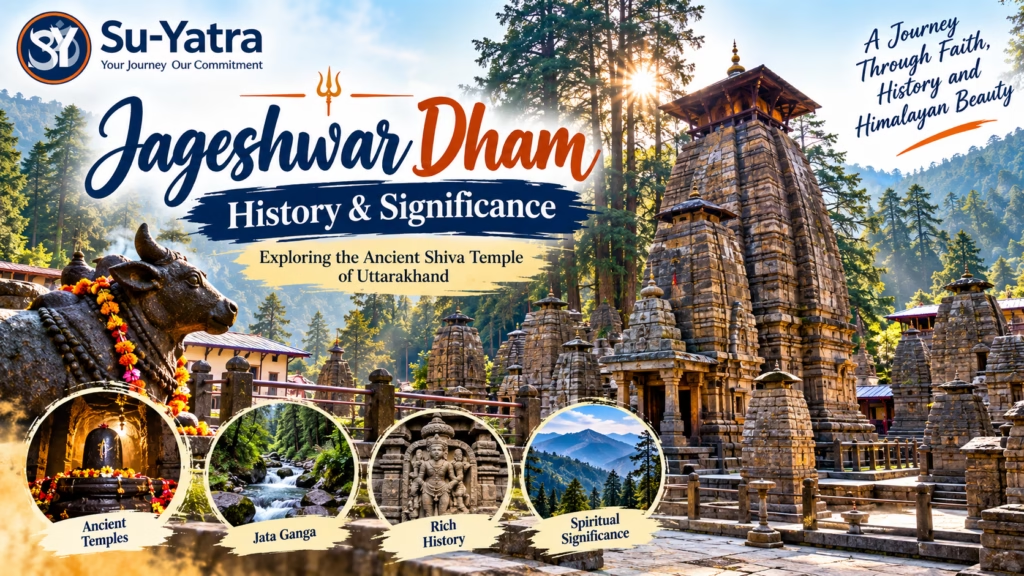
Jageshwar Dham History & Significance-Uttarakhand is widely known for its magnificent Himalayan landscapes, sacred rivers, ancient temples, and spiritual traditions. Among the many pilgrimage destinations of this Himalayan state, Jageshwar Dham holds a distinctive place. Located in the Almora district of Kumaon, Jageshwar is surrounded by dense deodar forests and the peaceful Jata Ganga stream. Its ancient stone temples, intricate carvings, religious traditions, and connection with Lord Shiva make it an important destination for pilgrims, history enthusiasts, architecture lovers, and spiritual travellers.
Jageshwar is not simply a single temple but a historic temple complex containing numerous ancient shrines. The District Almora administration describes the complex as consisting of 124 large and small temples, while Incredible India describes it as a complex of more than 125 ancient temples. The site is also protected as a monument of national importance, with the Archaeological Survey of India responsible for its conservation.
For travellers exploring spiritual destinations in Kumaon, Jageshwar can also be combined with places such as Nainital, Almora, Mukteshwar, and Kainchi Dham. This makes Kainchi Dham Yatra Packages a useful starting point for travellers who want to explore several spiritual and cultural destinations of the region in one journey.
Where Is Jageshwar Dham Located?
Jageshwar Dham is situated in the Almora district of Uttarakhand, in the Kumaon Himalayan region. It lies amid a beautiful deodar forest, with the Jata Ganga stream flowing through the surrounding landscape.
The location itself contributes greatly to the spiritual character of the temple complex. Tall deodar trees surround the ancient stone structures, while the mountain environment creates a peaceful atmosphere for prayer and meditation.
According to the District Almora administration, Jageshwar is well connected by road. Kathgodam is the nearest major railway connection, while Pantnagar is the nearest airport mentioned by the district administration. Road travel remains one of the practical ways to reach the destination.
Travellers who are planning Kainchi Dham Yatra Packages can consider extending their journey toward Almora and Jageshwar, depending on the number of days available.
The Ancient History of Jageshwar Dham
The history of Jageshwar is particularly fascinating because the exact date of construction of the entire temple complex is not established through one single historical record.
The Archaeological Survey of India notes that inscriptions indicate the presence of shrines at Jageshwar as early as the eighth century, while also stating that these were probably not the first shrines erected at the location. The District Almora website places the temple complex within the post-Gupta and pre-medieval period and describes it as being around 2,500 years old.
This means that Jageshwar’s history should be understood as a long process of religious activity, temple construction, patronage, renovation, and preservation rather than as the creation of a single temple at one specific point in time.
The complex developed over different historical periods, with various rulers and communities contributing to its religious and architectural heritage.
For travellers interested in ancient Indian history, this layered development is one of the most interesting aspects of Jageshwar Dham.
Connection With the Katyuri Dynasty
The Katyuri period is particularly important in the history of temple construction in the Kumaon region.
The Archaeological Survey of India states that large-scale temple-building activity at Jageshwar took place during the period of the Katyuris of Central Himalaya. The ASI also notes that the temples may have been reconstructed into their present forms during this period.
The Katyuri rulers were significant patrons of religious institutions in the Himalayan region. Their association with temple construction can be seen at several important sites across present-day Uttarakhand.
Jageshwar therefore represents not only a religious centre but also an important example of the cultural and architectural development of medieval Kumaon.
Travellers booking Kainchi Dham Yatra Packages and extending their itinerary to Jageshwar can experience this historical connection firsthand by visiting the ancient stone temples and observing their architectural details.
Later Patronage and the Chand Dynasty
The history of Jageshwar did not end with the Katyuri period. The temple complex continued to receive patronage during later periods, including under the Chand rulers of Kumaon.
Historical and tourism sources note that the Chand rulers also supported the Jageshwar temples. This continued religious patronage helped preserve the importance of Jageshwar as a Shaiva pilgrimage centre in the Kumaon region.
Inscriptions found at the site provide valuable evidence about different periods of temple activity and religious patronage. The presence of inscriptions also makes Jageshwar important from an archaeological perspective.
The combination of living religious traditions and historical evidence gives Jageshwar a unique character among Uttarakhand’s pilgrimage destinations.
The Architectural Importance of Jageshwar
One of the most impressive features of Jageshwar is its architecture.
The temples are primarily constructed from stone and display variations of the North Indian Nagara architectural tradition. Curvilinear shikharas, carved stone doorways, sculptures, sanctums, and mandapas are among the architectural elements visible throughout the complex.
The ASI describes the main Jageshwar temple, locally known as Jagnath, as a temple dedicated to Lord Shiva as Yogishwara. It has a triratha sanctum with a curvilinear shikhara followed by a mandapa with a pyramidal roof.
Incredible India also identifies different architectural styles within the complex, including examples associated with the Nagara and Rekha-prasada traditions. The Maha Mrityunjay Temple, Dandeshwar Temple, Kuber Temple, Lakulisha shrine, and other structures demonstrate the architectural diversity found within the temple group.
For visitors, the complex can feel like an open-air museum where religious practice and historic architecture exist together.
Jageshwar and Lord Shiva
The central religious identity of Jageshwar is closely associated with Lord Shiva.
Several temples in the complex are dedicated to Shiva and different manifestations associated with Shaivism. The main Jageshwar shrine contains a Shiva lingam, while other important temples include the Maha Mrityunjay Temple and Dandeshwar Temple.
The Kumaon Mandal website notes that the principal temple in the Dandeshwar group enshrines a large natural rock as the linga emblem of Lord Shiva.
This strong association with Shaivism has made Jageshwar an important pilgrimage destination for devotees of Lord Shiva.
Is Jageshwar a Jyotirlinga?
Jageshwar’s connection with the concept of Jyotirlingas is an interesting subject within Hindu religious tradition.
Some devotional traditions and travel sources identify Jageshwar with one of the twelve Jyotirlingas, while other historical and official descriptions focus on its broader identity as an ancient Shaiva temple complex rather than making a definitive archaeological claim about its status as one of the twelve Jyotirlingas.
Therefore, travellers researching the subject should distinguish between religious belief and archaeological documentation.
Regardless of how the Jyotirlinga tradition is interpreted, Jageshwar remains an important and ancient centre of Shiva worship with a substantial temple heritage.
The Significance of the Jata Ganga
The natural surroundings of Jageshwar are an integral part of its spiritual identity.
The Jata Ganga stream flows through the temple area, adding to the peaceful atmosphere of the complex. The combination of flowing water, deodar forests, mountain air, and ancient temples creates an environment particularly suitable for quiet reflection.
The District Almora administration highlights the Jata Ganga stream and surrounding green mountains as important elements of the site’s setting.
For travellers coming from cities, the natural environment can be one of the most memorable parts of the experience.
Important Temples Within the Complex
Jageshwar is made up of numerous temples and shrines rather than a single standalone structure.
Some of the notable temples and structures associated with the complex include:
- Jageshwar Temple
- Dandeshwar Temple
- Maha Mrityunjay Temple
- Kuber Temple
- Surya Temple
- Navadurga Temple
- Lakulisha Temple
- Navagraha shrine
- Chandika Temple
- Pushti Devi Temple
The National Mission on Monuments and Antiquities also records sculptures associated with the Jageshwar temple complex, including representations of Uma-Maheshwar, Surya, Durga, Vishnu and Lakshmi, Ganesha, Kartikeya, Navagraha, and Shiva-Parvati.
This variety demonstrates that the religious landscape of Jageshwar extends beyond a single deity or shrine.
Jageshwar as a Place for Meditation and Spiritual Reflection
The peaceful setting of Jageshwar has long contributed to its appeal as a spiritual destination.
The District Almora administration specifically notes that the location is suitable for meditation.
Unlike heavily urbanized pilgrimage destinations, Jageshwar is surrounded by forests and mountains. Visitors can spend time exploring the temples, sitting quietly near the complex, observing the architecture, or simply experiencing the natural environment.
For travellers interested in combining multiple spiritual experiences, Kainchi Dham Yatra Packages can be planned with additional destinations such as Jageshwar, allowing visitors to experience different spiritual traditions within the Kumaon region.
Jageshwar Archaeological Museum
The historical importance of Jageshwar is further supported by the presence of an archaeological museum maintained by the Archaeological Survey of India.
The museum contains sculptures and archaeological objects associated with the region. Incredible India highlights sculptures such as Uma-Maheshwar and Surya among the museum’s attractions.
A visit to the museum can help travellers understand the artistic and historical context of the temples instead of viewing them only as places of worship.
For students, history enthusiasts, photographers, architecture lovers, and cultural travellers, the museum adds another dimension to a visit to Jageshwar.
Festivals at Jageshwar Dham
Religious festivals add another dimension to the living heritage of Jageshwar.
The Jageshwar Monsoon Festival is associated with the Hindu month of Shravan, while the annual Shivaratri celebrations are also important events at the temple complex. Incredible India identifies both the monsoon festival and Shivaratri Mela among the major celebrations associated with Jageshwar.
During festival periods, the atmosphere around the temple becomes particularly vibrant as devotees gather for prayers and religious activities.
Travellers planning their visit around major festivals should consider advance accommodation and transportation arrangements because visitor numbers may increase.
Jageshwar and Kumaon’s Spiritual Tourism
Jageshwar is part of a much larger spiritual landscape in Kumaon.
The region includes several important destinations such as Kainchi Dham, Nainital, Almora, Mukteshwar, Kasar Devi, and other temples and cultural sites.
This makes the area particularly suitable for travellers who want to combine pilgrimage with sightseeing.
A thoughtfully designed itinerary using Kainchi Dham Yatra Packages can potentially include Jageshwar as an additional spiritual destination, depending on the starting point, duration, and route.
Such a journey allows travellers to experience different aspects of Uttarakhand—from the devotional atmosphere of Kainchi Dham to the ancient Shaiva heritage of Jageshwar.
Best Time to Visit Jageshwar Dham
Jageshwar can be visited during different seasons, but travellers should consider Himalayan weather before planning their journey.
Summer can be comfortable compared with the hotter plains, while the monsoon season brings lush greenery but may also create challenging road conditions.
Autumn can offer pleasant travel conditions and beautiful landscapes. Winters can be cold, particularly in the early morning and evening, so warm clothing is recommended.
Anyone combining Jageshwar with Kainchi Dham Yatra Packages should consider the overall route and weather conditions before finalizing the travel dates.
How Jageshwar Connects With a Kainchi Dham Journey
Kainchi Dham and Jageshwar are different kinds of spiritual destinations, but both are located within the broader Kumaon region.
Kainchi Dham is associated with Neem Karoli Baba and Lord Hanuman, while Jageshwar is an ancient Shaiva temple complex with centuries of architectural and religious history. Uttarakhand Tourism describes Kainchi Dham as a pilgrimage centre and Hanuman temple and ashram founded by Neem Karoli Baba in 1962.
This difference can actually make them complementary stops on a Kumaon spiritual journey.
Travellers searching for Kainchi Dham Yatra Packages may therefore consider an extended itinerary that includes Jageshwar, especially if they want to explore both contemporary spiritual traditions and ancient temple heritage.
Responsible Tourism at Jageshwar
Jageshwar is both a living religious site and a protected heritage environment. Visitors should therefore treat the temples, sculptures, inscriptions, forests, and surrounding landscape with care.
Tourists should avoid touching or climbing on protected structures, should not damage carvings or inscriptions, and should dispose of waste responsibly.
Respecting temple customs and following instructions from temple authorities and conservation staff is equally important.
Responsible tourism helps ensure that the historic heritage of Jageshwar remains available for future generations.
Final Thoughts – Jageshwar Dham History & Significance
Jageshwar Dham represents one of the most fascinating intersections of spirituality, history, architecture, and nature in Uttarakhand. Its ancient temples, connection with Lord Shiva, deodar forests, Jata Ganga stream, archaeological remains, and continuing religious traditions make it much more than an ordinary tourist attraction.
The history of Jageshwar developed across different periods, with evidence of ancient religious activity, major temple-building under the Katyuris, later patronage, and continued preservation under modern archaeological institutions. The Archaeological Survey of India continues to recognize and protect important monuments within the Jageshwar complex.
For travellers interested in exploring the spiritual side of Kumaon, Jageshwar can be an excellent addition to a wider itinerary. Those considering Kainchi Dham Yatra Packages can explore the possibility of combining Kainchi Dham with Jageshwar, Almora, Nainital, Mukteshwar, and other destinations according to their available time.
Ultimately, the importance of Jageshwar lies in the way its ancient heritage continues to live alongside the natural beauty and spiritual traditions of the Himalayas. A visit here offers an opportunity not only to seek blessings but also to understand a remarkable chapter of Uttarakhand’s cultural and architectural history.
Su-Yatra offers different types of Kainchi Dham Yatra Packages–
1-Kainchi Dham Package With Kasar Devi, Jageshwar & Patal Bhuvneshwar


