
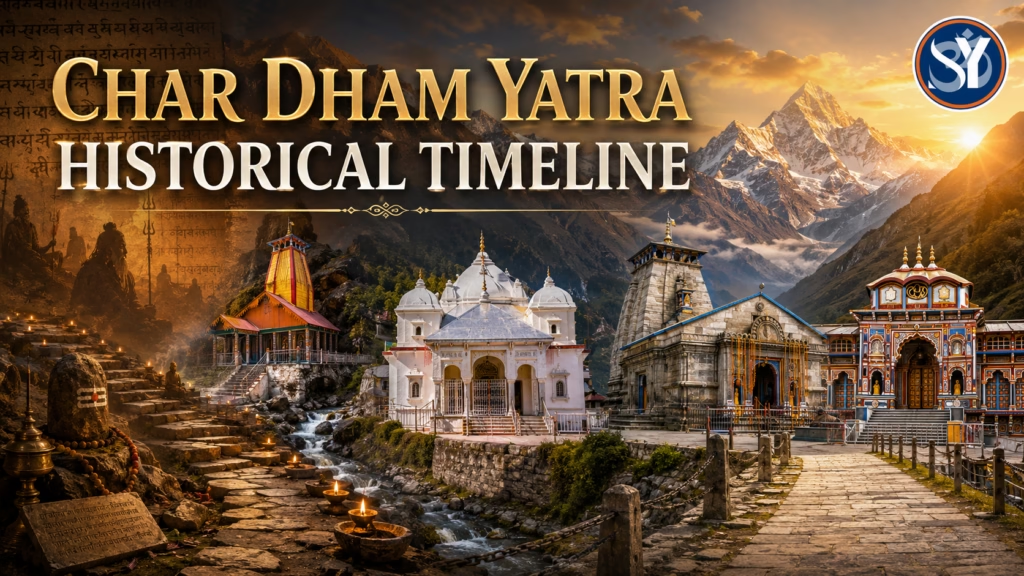
Char Dham Yatra Historical Timeline-The Char Dham Yatra of Uttarakhand is not merely a journey between four temples. It is a passage through thousands of years of mythology, spiritual tradition, royal patronage, Himalayan culture and religious history.
The pilgrimage connects Yamunotri, Gangotri, Kedarnath and Badrinath. Yamunotri is dedicated to Goddess Yamuna, Gangotri to Goddess Ganga, Kedarnath to Lord Shiva and Badrinath to Lord Vishnu. Together, they form the famous Himalayan pilgrimage circuit commonly known as the Chota Char Dham.
The exact beginning of the pilgrimage cannot be assigned to a single year. The sacred geography is rooted in ancient religious traditions, while the temples visible today were established, renovated or reconstructed during different historical periods. Many popular accounts blend mythology, oral tradition and documented history.
Understanding this timeline can make a Luxury Chardham Yatra Package much more meaningful. Instead of visiting the temples only as tourist attractions, pilgrims can recognise them as living institutions shaped by sages, rulers, priests, local communities and generations of devotees.
This historical timeline follows the evolution of Char Dham from the mythological age to the modern era.
Before Recorded History: The Sacred Himalayan Landscape
Long before permanent temples, roads or organised travel existed, the Himalayas were regarded as a sacred landscape. Ancient Indian traditions describe the mountains as the dwelling place of deities, rishis, yogis and seekers.
The rivers flowing from the Himalayas were not viewed simply as sources of water. They were worshipped as divine mothers carrying purity, nourishment and spiritual grace to the plains.
Yamuna and Ganga became central to Indian civilisation and religious life. Shiva was associated with remote mountains, meditation and renunciation, while the Badrinath region became connected with Lord Vishnu and the sages Nara and Narayana.
This early sacred geography provided the foundation for what would eventually develop into the Char Dham Yatra.
Mythological Age: Goddess Yamuna and Sage Asit Muni
The spiritual history of Yamunotri begins with Goddess Yamuna, traditionally described as the daughter of Surya, the Sun God, and the sister of Yama, the deity connected with death and justice.
Devotees believe that worshipping Goddess Yamuna helps free a person from the fear of death and grants spiritual protection.
Another important Yamunotri tradition concerns Sage Asit Muni. According to the legend, the sage lived in this region and bathed daily in both the Yamuna and the Ganga.
When advancing age made it impossible for him to travel to Gangotri, a stream of the Ganga is believed to have appeared near Yamunotri. The story symbolises divine compassion towards a sincere devotee.
The actual source of the Yamuna is associated with a glacier high in the Kalind mountain region. Because that area is difficult to approach, pilgrims offer prayers at the accessible shrine below. The Uttarkashi district administration identifies Yamunotri as the source of the Yamuna and the westernmost shrine of the Uttarakhand Char Dham. Uttarkashi District Administration
Mythological Age: King Bhagiratha and the Descent of Ganga
Gangotri’s earliest timeline is connected with one of Hinduism’s best-known sacred stories—the descent of Goddess Ganga.
According to tradition, King Sagara’s sons were reduced to ashes and could attain liberation only through the purifying waters of Ganga. Their descendant, King Bhagiratha, performed intense penance to bring the celestial river to Earth.
Ganga’s force was believed to be too powerful for the Earth to withstand. Lord Shiva therefore received the descending river in his matted locks and released her through controlled streams.
A sacred stone near Gangotri Temple, called Bhagirath Shila, is traditionally regarded as the place where King Bhagiratha performed his penance. This legend explains why the upper river is known as Bhagirathi.
The river becomes known as Ganga after the Bhagirathi meets the Alaknanda at Devprayag. The physical source is at Gaumukh in the Gangotri Glacier, while Gangotri Temple is the principal accessible shrine dedicated to the goddess. Uttarkashi District Administration
Mahabharata Tradition: The Pandavas and Kedarnath
Kedarnath’s mythological timeline is closely connected with the Pandavas.
After the Mahabharata war, the five brothers reportedly felt burdened by the destruction and deaths caused during the conflict. They sought Lord Shiva to ask for forgiveness and spiritual purification.
Shiva did not wish to meet them and took the form of a bull. When the Pandavas recognised him, he attempted to disappear into the earth. Bhima tried to hold him, but different portions of the bull manifested at five locations.
The hump is worshipped at Kedarnath. Other manifestations are associated with Tungnath, Rudranath, Madhyamaheshwar and Kalpeshwar. These five temples collectively form the Panch Kedar.
The official history of Rudraprayag district connects Kedarnath with the Pandavas’ penance and states that the shrine was later revived by Adi Shankaracharya. Rudraprayag District Administration
This tradition places Kedarnath within the sacred world of the Mahabharata, although the date of the present temple cannot be established from the legend alone.
Puranic Traditions: Badrikashram and Nara-Narayana
The Badrinath region was known traditionally as Badrikashram and is associated with Lord Vishnu, Goddess Lakshmi and the sages Nara and Narayana.
According to a popular legend, Lord Vishnu performed intense meditation in the Himalayan cold. Goddess Lakshmi protected him by taking the form of a badri tree, commonly associated with the Himalayan berry or jujube.
The area became known as Badri Van, and Vishnu came to be worshipped as Badrinath or Badri Narayan.
The surrounding mountains are still associated with Nar and Narayan. Neelkanth Peak rises dramatically near the shrine, strengthening the spiritual character of its natural setting.
Nearby Mana village contains places connected in tradition with Ved Vyasa, Lord Ganesha and the Pandavas. These associations show that the history of Badrinath extends beyond the main temple building into a much larger sacred landscape.
Ancient Pilgrimage Routes and the Age of the Sages
In the ancient and early historical periods, Himalayan pilgrimage was extremely difficult. There were no modern roads, vehicles, hotels or communication facilities.
Ascetics and determined pilgrims travelled through forests, crossed rivers and climbed steep mountain paths. The journey could take several weeks or months.
Small shrines, caves, seasonal shelters and hermitages probably developed along these routes. Local residents guided travellers, provided food and helped maintain paths. Religious knowledge was transmitted through oral traditions, recitations and the teachings of wandering sages.
The wider Uttarkashi region finds mention in religious traditions associated with the Mahabharata and the Kedar Khand of the Skanda Purana. The district’s official history describes the region as a place where sages performed penance and where Himalayan communities lived from ancient times. Uttarkashi District Administration
A modern Luxury Chardham Yatra Package may complete the circuit in days, but the original pilgrimage demanded extraordinary endurance and surrender.
Eighth Century: The Influence of Adi Shankaracharya
The eighth century is one of the most important periods in the commonly accepted Char Dham timeline.
Adi Shankaracharya is traditionally credited with reviving Hindu pilgrimage centres, strengthening monastic institutions and establishing spiritual connections between different regions of India.
His name is especially associated with Badrinath and Kedarnath. Uttarakhand Tourism states that the present Kedarnath structure is believed to be over 1,200 years old and associates its establishment with Adi Shankaracharya around the eighth century. Uttarakhand Tourism
At Badrinath, tradition holds that Adi Shankaracharya discovered the black stone image of Lord Badri Narayan in Narad Kund and installed it in a shrine near Tapt Kund. The image was later placed in the present temple.
The Badrinath-Kedarnath Temple Committee preserves this account and describes the image as a black stone representation of Lord Badri Narayan. Badrinath-Kedarnath Temple Committee
Adi Shankaracharya is also associated with Jyotirmath, traditionally known as Joshimath, which became an important centre of learning and the winter religious base connected with Badrinath.
His work helped integrate distant Himalayan shrines into an all-India pilgrimage network. The tradition of appointing a Namboodiri Brahmin from Kerala as Badrinath’s chief priest, known as the Rawal, reflects this connection between northern and southern India.
Early Medieval Period: Development of Temple Traditions
Following the revival associated with Adi Shankaracharya, the shrines became more firmly established within regional and national religious life.
Pilgrims, monks and scholars carried stories about the Himalayan temples across India. Royal families donated land, wealth and resources to support worship and pilgrim facilities.
Temple practices became more organised, and hereditary communities assumed responsibility for rituals, maintenance and seasonal movement of the deities.
However, the extreme environment meant that buildings could not remain unchanged. Snow, avalanches, earthquakes and rainfall periodically damaged temples and settlements. Consequently, the history of Char Dham is one of continued rebuilding rather than uninterrupted architectural preservation.
Medieval Garhwal: Royal Patronage and Pilgrimage Support
The rulers of Garhwal played an important role in protecting pilgrimage routes and supporting religious institutions.
Badrinath received substantial royal patronage. Garhwal rulers helped maintain the temple, supported priests and provided resources for pilgrims. They were traditionally regarded as representatives or servants of Badri Vishal.
The temple developed through several phases of renovation and enlargement. Its colourful present appearance differs considerably from the austere stone architecture of Kedarnath.
Kedarnath also remained an important Shaiva pilgrimage centre during the medieval period. Its massive stone construction and high-altitude location made it a remarkable symbol of religious determination.
The pilgrimage at this time still required long journeys on foot. Dharamshalas, village shelters and charitable food arrangements became vital elements of the route.
Seventeenth and Eighteenth Centuries: Continued Restoration
During the seventeenth and eighteenth centuries, Himalayan temples continued to receive assistance from rulers and devotees from different parts of India.
Badrinath underwent expansion and repair under royal patronage. The temple’s history reflects the repeated need to restore buildings affected by age, weather and geological activity.
Kedarnath’s stone structure remained comparatively austere. Its survival in such a severe climate contributed to its reputation as an architectural wonder.
The sacred locations of Yamunotri and Gangotri also continued to attract pilgrims, although their present temple structures were developed more clearly during the following century.
1803: The Garhwal Earthquake and Political Change
The beginning of the nineteenth century brought both natural and political upheaval.
A major earthquake struck the Garhwal region in 1803, damaging settlements and religious structures. Badrinath was among the temples that required significant repair and reconstruction.
During the same period, Gorkha forces entered Garhwal. The Uttarkashi district history records that the Gorkhas invaded Garhwal in 1803 and that Amar Singh Thapa became governor of the region. Uttarkashi District Administration
This political change would become directly connected with the development of Gangotri Temple.
Early Nineteenth Century: Construction of Gangotri Temple
The present Gangotri Temple is generally credited to Gorkha General Amar Singh Thapa.
The temple was constructed near the Bhagirathi River and close to Bhagirath Shila. Its white stone appearance stands in striking contrast to the surrounding deodar trees and mountain slopes.
The Uttarkashi district administration identifies Amar Singh Thapa as the builder of the temple. Uttarkashi District Administration
Later royal patrons are believed to have supported repairs and improvements. The establishment of a formal temple gave a permanent architectural centre to a sacred place already associated with the ancient story of Ganga’s descent.
Nineteenth Century: Development of Yamunotri Temple
Yamunotri Temple is commonly linked with nineteenth-century royal patronage. Accounts associate its construction or renovation with rulers of Tehri Garhwal and Maharani Guleria of Jaipur.
Different traditions vary regarding the precise sequence. This is why historical writing should avoid presenting a single disputed account as unquestionable fact.
What is clear is that the temple required repeated reconstruction because of the region’s difficult climate and vulnerability to natural disasters.
The shrine developed near Surya Kund, the famous hot-water spring where pilgrims prepare rice or potatoes as prasad. Divya Shila, a sacred stone worshipped before temple entry, also became an important part of the ritual sequence.
1815 Onwards: Garhwal Under New Administration
British forces removed the Gorkhas from much of Garhwal in 1815. The region was subsequently divided.
Eastern Garhwal came under British administration, while western Garhwal was returned to the Garhwal royal family and became the princely state of Tehri Garhwal.
The Char Dham shrines consequently existed within changing political jurisdictions. Yet pilgrimage continued because temple traditions were maintained by priests, local rulers and mountain communities.
Colonial-period travellers and surveyors began documenting Himalayan geography and pilgrimage routes more systematically. Their records provide historical descriptions of routes that were still extremely challenging.
Late Nineteenth Century: Formalising Temple Administration
As pilgrim numbers increased, temple management became more complex.
At Badrinath, the Rawal traditionally exercised considerable authority, while the Tehri Darbar held supervisory responsibilities. The Badrinath-Kedarnath Temple Committee notes that a management arrangement was introduced in 1899, though it later led to administrative friction. Badrinath-Kedarnath Temple Committee
This period marked a transition from largely customary management towards more formal administrative structures.
Facilities remained limited. Pilgrims relied heavily on dharamshalas, charitable kitchens, local guides and village hospitality.
Early Twentieth Century: Expanding Pilgrimage Networks
The early twentieth century saw gradual improvements in communication and access.
Bridle paths, suspension bridges and rest facilities made parts of the journey more manageable, though pilgrims still travelled long distances on foot or with ponies and palanquins.
Religious organisations and charitable groups established shelters and food services. Printed pilgrimage guides began circulating more widely, allowing devotees to learn about routes before travelling.
The Char Dham Yatra was slowly becoming accessible to a broader section of society while preserving its demanding spiritual character.
1939: Formation of the Temple Committee
A significant administrative milestone occurred in 1939 with the legal framework that led to the Badrinath-Kedarnath Temple Committee.
The committee became responsible for the management of Badrinath, Kedarnath and several associated temples. Its role included overseeing worship, property, pilgrim facilities and temple administration.
The official committee states that it was constituted under the 1939 Act and also manages numerous subordinate temples and dharamshalas along the pilgrimage routes. Badrinath-Kedarnath Temple Committee
This development helped shift temple management into a more structured institutional system.
1947–1960: Independence and Administrative Reorganisation
After India gained independence in 1947, the political organisation of the Himalayan region changed again.
Tehri Garhwal merged with Uttar Pradesh in 1949. Uttarkashi district was created in 1960 from areas previously connected with Tehri Garhwal.
These changes brought the shrines under modern district administration while traditional temple practices continued.
Government departments gradually assumed greater responsibility for roads, public safety, medical support and pilgrimage infrastructure.
1960s–1980s: The Road-Building Era
The development of motorable roads transformed the Char Dham Yatra.
Previously, pilgrims walked for much of the journey from the plains. New roads allowed buses and private vehicles to reach locations closer to the temples.
Gangotri and Badrinath became directly accessible by road. Yamunotri continued to require a final trek, while Kedarnath remained connected through a longer mountain trail.
Improved accessibility increased pilgrim numbers and encouraged the development of hotels, guesthouses, restaurants and transport services.
This era laid the foundation for today’s organised tours and the eventual development of the Luxury Chardham Yatra Package.
1991: Uttarkashi Earthquake and Reconstruction
The Uttarkashi earthquake of 1991 caused widespread damage across the region.
Mountain settlements, roads and buildings were affected, reminding residents and pilgrims of the geological vulnerability of the Himalayas. Religious structures in the wider region required inspection and repair.
The disaster reinforced the need for stronger construction, emergency planning and responsible development along pilgrimage routes.
2000: Formation of Uttarakhand
On 9 November 2000, Uttarakhand was created as a separate state, initially under the name Uttaranchal.
The Char Dham Yatra became central to the new state’s cultural identity, tourism strategy and infrastructure planning.
Government agencies invested in roads, registration, sanitation, medical facilities and route management. The pilgrimage became one of Uttarakhand’s most important religious and economic activities.
Early Twenty-First Century: Growth of Organised Travel
During the early 2000s, improved roads, mobile communication and online information changed the pilgrimage experience.
Travellers increasingly booked packaged tours rather than arranging each service separately. Private vehicles, premium hotels and planned itineraries made the circuit more accessible to families and senior citizens.
Helicopter services, particularly for Kedarnath, introduced another major change. Pilgrims who could not complete the trek gained an alternative, subject to weather, aviation rules and passenger restrictions.
The concept of a Luxury Chardham Yatra Package developed during this period. Luxury in the Himalayas came to mean dependable coordination, comfortable vehicles, better accommodation and attentive support rather than metropolitan facilities at every destination.
June 2013: The Kedarnath Disaster
The 2013 disaster was one of the most tragic events in the modern history of the Char Dham Yatra.
Extreme rainfall, flooding and massive debris flows devastated the Mandakini valley. Kedarnath town and several settlements along the route suffered severe destruction and an enormous loss of life.
The stone temple remained standing even though the surrounding area was heavily damaged. A large rock behind the shrine, now widely called Bhim Shila, is believed to have diverted part of the debris.
The disaster transformed pilgrimage planning. It highlighted the need for weather monitoring, evacuation procedures, regulated construction and stronger emergency systems.
2014–2018: Reconstruction and Safer Infrastructure
After the disaster, extensive reconstruction began around Kedarnath and along affected routes.
Work included rebuilding paths, improving drainage, constructing retaining structures, reorganising the temple surroundings and developing emergency facilities.
New accommodation and pilgrim-management systems were introduced. Authorities increased attention to medical assistance, crowd regulation and weather alerts.
For travellers booking a Luxury Chardham Yatra Package, this period introduced greater expectations of professional risk communication and contingency planning.
2019: Increasing Use of Digital Services
By the end of the decade, digital systems played a growing role in the pilgrimage.
Online registration, hotel bookings, helicopter reservations, vehicle permits and travel updates became increasingly common. Pilgrims could access information more easily, though online fraud also emerged as a serious concern.
Travellers were advised to use authorised portals and verified tour operators, particularly for helicopter tickets.
2020–2021: Pandemic Restrictions
The COVID-19 pandemic caused unprecedented disruption to the Char Dham Yatra.
Temple access, pilgrim numbers and interstate travel were restricted. Health certificates, testing rules and controlled entry became part of pilgrimage management.
Although the temples continued their essential rituals, public participation was severely limited.
This period demonstrated the difference between a temple’s continuous religious tradition and unrestricted physical access for pilgrims.
2022 Onwards: A New Era of High Pilgrim Numbers
After pandemic restrictions eased, the Char Dham Yatra experienced a sharp rise in demand.
Digital registration, daily monitoring, medical screening and traffic management became increasingly important. Authorities placed greater emphasis on health risks connected with high altitude, cold weather and physical exertion.
The official pilgrimage system now combines ancient rituals with modern administration, online databases, transport regulation and emergency response.
A contemporary Luxury Chardham Yatra Package may include premium road transport, carefully selected hotels, registration assistance, helicopter-booking guidance and on-trip support. However, it must still operate within government rules and Himalayan weather conditions.
The Timeline of Seasonal Worship
One historical feature that has remained constant is the seasonal nature of the temples.
Heavy snowfall makes the four high-altitude shrines inaccessible during winter. Their portals generally close around October or November and reopen during spring, with exact dates determined according to religious traditions.
Worship continues at winter seats:
- Goddess Yamuna is worshipped at Kharsali.
- Goddess Ganga is worshipped at Mukhba.
- Lord Kedarnath is worshipped at Omkareshwar Temple in Ukhimath.
- Badrinath’s winter traditions are connected with Joshimath and the Narsingh Temple.
These seasonal movements show that Char Dham is not limited to four buildings. It is a network of temples, villages, priests, processions and communities.
Char Dham Historical Timeline at a Glance
| Period | Important development |
|---|---|
| Mythological age | Legends of Yamuna, Ganga, the Pandavas, Shiva and Badri Narayan |
| Ancient period | Sages, ascetics and pilgrims establish the Himalayas as sacred geography |
| Around 8th century | Adi Shankaracharya associated with revival of Badrinath and Kedarnath |
| Medieval period | Garhwal rulers and religious communities support temples and routes |
| 1803 | Major earthquake and Gorkha invasion affect the Garhwal region |
| Early 19th century | Gangotri Temple associated with Amar Singh Thapa |
| 19th century | Yamunotri Temple developed and reconstructed under royal patronage |
| 1899 | Formal management arrangement introduced for Badrinath |
| 1939 | Legal framework establishes organised management of Badrinath and Kedarnath |
| 1949 | Tehri Garhwal merges with Uttar Pradesh |
| 1960 | Uttarkashi district is created |
| 1960s–1980s | Motorable roads transform the pilgrimage |
| 1991 | Uttarkashi earthquake affects the region |
| 2000 | Uttarakhand becomes a separate state |
| 2000s | Organised tours, improved hotels and helicopter services expand |
| 2013 | Kedarnath disaster changes safety and infrastructure planning |
| 2014 onwards | Reconstruction and modern pilgrim-management systems develop |
| 2020–2021 | Pandemic restrictions limit public pilgrimage |
| Present era | Registration, digital services and managed travel shape the modern Yatra |
How a Luxury Chardham Yatra Package Connects Travellers with History
Choosing a Luxury Chardham Yatra Package allows pilgrims to explore this historical journey with improved comfort and coordination.
Depending on the itinerary, a professionally planned package may include:
- Comfortable private transportation
- Carefully selected accommodation
- Experienced mountain drivers
- Meal arrangements
- Registration guidance
- Visits to historically important temples
- Kedarnath helicopter-booking assistance
- Support during delays or route changes
- Special planning for families and senior citizens
- Information about temple traditions and local customs
A knowledgeable organiser can also include places such as Uttarkashi’s Vishwanath Temple, Guptkashi, Ukhimath, Joshimath, Mana village, Devprayag and other spiritually significant destinations.
However, even a premium package cannot guarantee favourable weather, uninterrupted roads or helicopter operations. Historical understanding should be accompanied by realistic expectations and respect for the mountains.
Why Preserving the Timeline Matters
The Char Dham timeline is still being written. Every new road, hotel and digital service becomes part of its modern history, but development must not damage the sacred environment that made the pilgrimage meaningful.
Excessive construction, traffic, plastic waste and pressure on water resources threaten the fragile Himalayas.
Pilgrims travelling through a Luxury Chardham Yatra Package should practise responsible tourism by carrying reusable bottles, avoiding litter, respecting temple rules and following local environmental guidelines.
Protecting the rivers, glaciers, forests and mountain communities is essential for ensuring that future generations can continue the pilgrimage.
Frequently Asked Questions
How old is the Char Dham Yatra?
Its mythology and sacred geography are ancient, but there is no single confirmed year when the complete Uttarakhand circuit began. The current pilgrimage developed gradually through scriptural traditions, temple construction, royal patronage and organised routes.
Did Adi Shankaracharya establish Char Dham?
Adi Shankaracharya is traditionally associated with reviving Badrinath and Kedarnath and strengthening pilgrimage networks. However, the sacred importance of these places is believed to predate him.
Which Char Dham temple is considered the oldest?
Kedarnath is often regarded as the oldest surviving temple structure in the circuit, although its precise construction date remains debated. Devotional tradition connects the shrine with the Pandavas.
When was Gangotri Temple built?
The present Gangotri Temple is generally associated with Gorkha General Amar Singh Thapa in the early nineteenth century.
When was Yamunotri Temple built?
The present temple tradition is commonly connected with nineteenth-century royal patrons from Tehri Garhwal and Jaipur. The structure has undergone reconstruction because of natural damage.
What changed after the 2013 Kedarnath disaster?
The disaster led to extensive reconstruction, improved paths, greater weather monitoring, stronger emergency planning and changes in pilgrim management.
Is a Luxury Chardham Yatra Package suitable for senior citizens?
It can be suitable when it includes realistic travel days, adequate rest, comfortable transport and medical preparedness. Travellers should consult their doctors before visiting high-altitude destinations.
Final Thoughts-Char Dham Yatra Historical Timeline
The Char Dham Yatra historical timeline is a story of continuity through change.
It begins in a sacred mythological landscape where Ganga descended from heaven, Yamuna offered protection, the Pandavas sought Shiva and Vishnu meditated beneath the badri tree. It continues through the influence of Adi Shankaracharya, the patronage of Himalayan rulers, the construction of temples and the dedication of mountain communities.
The nineteenth century brought formal temple structures and political transformation. The twentieth century introduced institutional management and motorable roads. The twenty-first century added digital registration, helicopter services, premium accommodation and modern emergency planning.
Yet the essence of the pilgrimage remains unchanged. Pilgrims still travel towards the sources of sacred rivers, climb through the mountains, endure uncertainty and seek divine grace.
A thoughtfully planned Luxury Chardham Yatra Package can provide comfort, organisation and dependable assistance. Historical knowledge adds another dimension by helping travellers understand the traditions preserved within every temple, procession and sacred landscape.
When devotees recognise the long journey that these shrines have taken through mythology, history, disaster and reconstruction, the Char Dham Yatra becomes more than a pilgrimage itinerary. It becomes an encounter with India’s living spiritual heritage


