
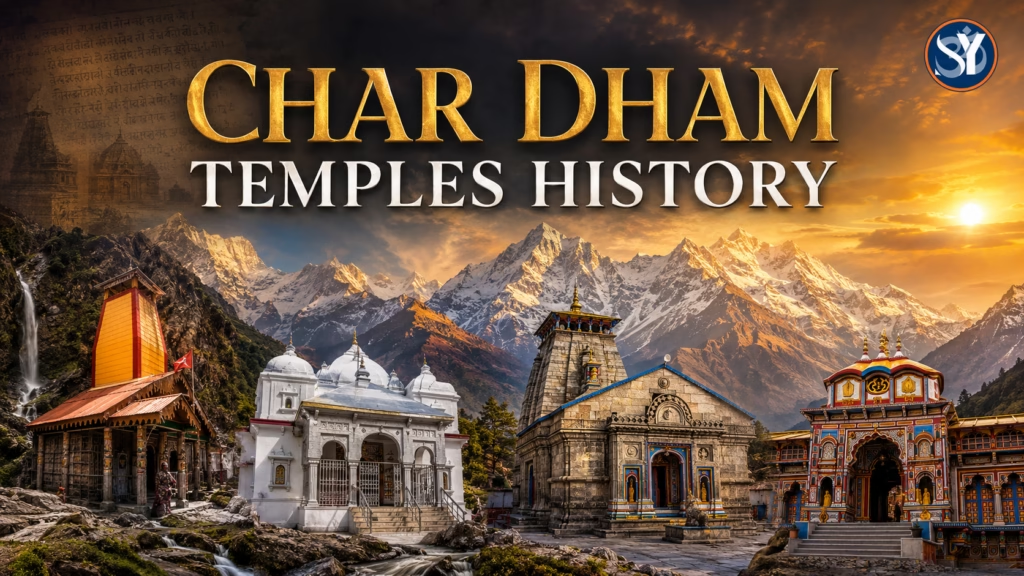
Char Dham Temples History-The Char Dham Yatra of Uttarakhand is one of India’s most respected spiritual journeys. It connects four sacred Himalayan shrines—Yamunotri, Gangotri, Kedarnath and Badrinath. Each temple represents a different divine presence, an ancient tradition and an important chapter in India’s religious heritage.
Yamunotri is dedicated to Goddess Yamuna, Gangotri honours Goddess Ganga, Kedarnath is dedicated to Lord Shiva, and Badrinath is the abode of Lord Vishnu. Together, these shrines create a spiritual circuit that brings together sacred rivers, Shaiva and Vaishnava traditions, mythology, Himalayan culture and centuries of pilgrimage.
The Uttarakhand circuit is often called the Chota Char Dham to distinguish it from the four great pilgrimage centres of Badrinath, Dwarka, Puri and Rameswaram located across India. However, the journey’s importance is anything but small. For devotees, visiting these four Himalayan temples represents purification, devotion, self-discovery and a movement towards moksha.
Today, travellers can undertake the pilgrimage with better roads, organised transport, comfortable accommodation and professional assistance through a Luxury Chardham Yatra. Yet behind these modern facilities lies a history shaped by sages, royal patrons, local communities, priests, natural disasters and an enduring tradition of faith.
This detailed guide explores the historical development, mythology, architecture and spiritual importance of all four Char Dham temples.
Understanding the Historical Character of Char Dham
The history of the Char Dham temples cannot be studied only through construction dates. These are living religious institutions whose identities have developed through multiple layers:
- Ancient scriptural traditions
- Regional folklore and oral history
- Associations with sages and spiritual teachers
- Temple construction and reconstruction
- Patronage from Himalayan kings and royal families
- Ritual practices preserved by priestly communities
- Pilgrimage routes maintained by local residents
- Modern administration and infrastructure
In several cases, the sacred importance of a place is believed to be much older than the present temple structure. A shrine may have been reconstructed after earthquakes, avalanches, heavy snowfall or other natural events while its spiritual tradition continued uninterrupted.
It is therefore important to distinguish devotional tradition from historically documented construction. Both have value, but they answer different questions. Archaeology and inscriptions may explain when a structure was built, while mythology explains why devotees consider the place sacred.
Traditional Order of the Char Dham Yatra
The pilgrimage is traditionally completed from west to east:
- Yamunotri
- Gangotri
- Kedarnath
- Badrinath
This order is followed by many pilgrims travelling from Haridwar or Rishikesh. The journey begins with the blessings of Goddess Yamuna, continues to Goddess Ganga, proceeds to Lord Shiva at Kedarnath and concludes with Lord Vishnu at Badrinath.
The sequence symbolically connects the life-giving power of sacred rivers with the transformative energies of Shiva and Vishnu. It also follows the geographical arrangement of the shrines across the Garhwal Himalayas.
A carefully organised Luxury Chardham Yatra usually follows this traditional route while including sufficient rest, comfortable transport and practical acclimatisation.
History of Yamunotri Temple
Yamunotri is the westernmost shrine of the Uttarakhand Char Dham. Located in Uttarkashi district, it is regarded as the spiritual source of the River Yamuna and the seat of Goddess Yamuna.
The actual glacial source is associated with the Champasar or Yamunotri Glacier near the Kalind mountain region. Because the upper glacial area is difficult to access, devotees worship at the temple situated lower down the mountain. The district administration describes Yamunotri as the source of the Yamuna and one of the four sacred sites of the Uttarakhand Char Dham. Uttarkashi District Administration
In Hindu tradition, Yamuna is considered the daughter of Surya, the Sun God, and the sister of Yama, the deity associated with death and justice. Devotees believe that worshipping Goddess Yamuna with sincerity can provide spiritual purification and freedom from the fear of death.
Legend of Sage Asit Muni
One of the best-known Yamunotri traditions is associated with Sage Asit Muni. According to the legend, the sage lived in this Himalayan region and bathed daily in both the Ganga and Yamuna rivers.
When old age made it impossible for him to travel to Gangotri, a stream of the Ganga is believed to have appeared near Yamunotri so that he could continue his sacred practice. The story expresses the idea that sincere devotion draws divine grace towards the devotee.
Construction and Reconstruction
The exact early history of the Yamunotri shrine is difficult to establish. Popular historical accounts associate the present temple tradition with royal patronage during the nineteenth century, particularly Maharani Guleria of Jaipur and rulers of Tehri Garhwal.
The structure has been repaired or rebuilt more than once because the region is vulnerable to harsh winters, earthquakes, heavy snowfall and landslides. This repeated reconstruction is an important part of Yamunotri’s story. The survival of the shrine reflects not only royal support but also the dedication of priests, local residents and pilgrims.
The present temple houses an image of Goddess Yamuna, commonly represented in dark stone. Close to the shrine are spiritually significant hot-water springs.
Surya Kund and Divya Shila
Surya Kund is a naturally heated spring near Yamunotri Temple. Pilgrims traditionally place rice or potatoes in a cloth bundle and cook them in the hot water. The prepared food is then accepted as prasad.
Before entering the main temple, devotees offer prayers at Divya Shila, a sacred stone pillar situated near the hot spring. This sequence of worship has become an integral part of the Yamunotri experience.
A Luxury Chardham Yatra can make the road journey and accommodation more comfortable, but the final approach still requires physical preparation. The mountain path, changing weather and limited facilities preserve the shrine’s traditional pilgrimage character.
History of Gangotri Temple
Gangotri Temple stands in Uttarkashi district on the banks of the Bhagirathi River. The river is known as Bhagirathi in its upper Himalayan course and takes the name Ganga after joining the Alaknanda at Devprayag.
The physical source of the river lies at Gaumukh in the Gangotri Glacier, which is reached by a separate high-altitude trek. Gangotri Temple serves as the principal place of worship for Goddess Ganga in this region. Uttarkashi District Administration
Legend of King Bhagiratha
Gangotri’s spiritual history is inseparable from the story of King Bhagiratha. According to Hindu tradition, the king performed intense penance to bring the celestial Ganga to Earth so that the souls of his ancestors could attain liberation.
The force of the descending river was believed to be so powerful that it could have destroyed the Earth. Lord Shiva received Ganga in his matted hair and released her through controlled streams, making her descent safe.
A sacred stone called Bhagirath Shila near Gangotri Temple is traditionally identified as the place where King Bhagiratha performed his penance. The story connects Gangotri with perseverance, ancestral duty, divine compassion and purification.
Construction by Amar Singh Thapa
The present Gangotri Temple is generally associated with Gorkha General Amar Singh Thapa. Official district information states that the temple was built by him near the Bhagirathi River. Uttarkashi District Administration
Amar Singh Thapa was an important military figure during the period of Gorkha influence in the Himalayan region. Later accounts associate the shrine with further repairs and royal patronage.
The temple’s light-coloured stone exterior, compact form and mountain setting create an appearance that is both dignified and peaceful. Unlike highly ornamented temples of the plains, Gangotri’s architecture reflects the practical requirements of a remote location exposed to snow and cold winds.
Winter Worship Tradition
Gangotri becomes difficult to access during winter because of heavy snowfall. When the temple closes, the ceremonial image of Goddess Ganga is taken to Mukhba village, where winter worship continues.
This seasonal movement demonstrates that a Himalayan deity’s worship is not limited to one building. When climate makes the main shrine inaccessible, the ritual tradition shifts to a lower village and continues among the community.
Travellers undertaking a Luxury Chardham Yatra during the regular pilgrimage season can experience this living tradition through temple prayers, river rituals and visits to nearby sacred sites.
History of Kedarnath Temple
Kedarnath is among the most powerful Shiva temples in India. It forms part of the Uttarakhand Char Dham, the Panch Kedar pilgrimage and the twelve Jyotirlingas associated with Lord Shiva.
The temple stands near the Mandakini River at an elevation of approximately 3,584 metres, surrounded by dramatic snow-covered peaks. The Badrinath-Kedarnath Temple Committee identifies Kedarnath as a Char Dham and Panch Kedar shrine as well as one of the twelve Jyotirlingas. Badrinath-Kedarnath Temple Committee
The Pandavas and Lord Shiva
According to the best-known legend, the Pandavas sought Lord Shiva after the Mahabharata war. Although they had fought for dharma, they felt burdened by the deaths caused during the conflict and wished to seek forgiveness.
Lord Shiva did not want to meet them and took the form of a bull. When the Pandavas recognised him, Shiva attempted to disappear into the ground. Bhima reportedly tried to hold the bull, but different parts of its body manifested at five locations.
The hump is worshipped at Kedarnath, while other manifestations are associated with Tungnath, Rudranath, Madhyamaheshwar and Kalpeshwar. Together, these shrines form the Panch Kedar.
Rudraprayag district’s official history connects Kedarnath with the Pandavas’ penance and the later revival of the shrine by Adi Shankaracharya. Rudraprayag District Administration
Antiquity and Adi Shankaracharya
Devotional tradition credits the Pandavas with establishing the earliest shrine at Kedarnath. The surviving temple is often associated with a later period, and its exact date remains debated.
Adi Shankaracharya is traditionally credited with reviving Kedarnath and strengthening the wider network of Hindu pilgrimage during the early medieval period. His samadhi is associated with the area behind the temple.
Rather than assigning the structure an unquestioned construction date, it is more accurate to understand Kedarnath as a temple that developed through ancient worship, medieval religious organisation and repeated preservation.
Remarkable Stone Architecture
Kedarnath Temple is constructed from large stone blocks fitted together to withstand severe Himalayan weather. Its heavy masonry, raised platform and compact form give it exceptional strength.
The sanctum contains an irregular stone formation worshipped as Lord Shiva in the form of the bull’s hump. The temple’s architectural power comes from simplicity rather than elaborate decoration.
Its location raises important historical questions: transporting, shaping and positioning heavy stones in such difficult terrain would have required extraordinary skill and organisation. The structure remains a powerful example of Himalayan temple-building knowledge.
Kedarnath and the 2013 Disaster
In June 2013, Kedarnath and the surrounding Mandakini valley experienced a devastating natural disaster. Floods, debris and intense rainfall caused enormous loss of life and widespread destruction.
The temple remained standing even though the surrounding settlement suffered severe damage. A large rock behind the shrine, popularly called Bhim Shila, is widely believed to have diverted part of the debris flow.
The survival of the temple became a modern chapter in its sacred history. Reconstruction and improved pilgrimage infrastructure followed, although the region remains environmentally sensitive.
A premium Luxury Chardham Yatra can provide experienced coordination, better planning and comfortable arrangements, but every pilgrim must respect weather alerts, health advisories and official route restrictions.
Winter Seat at Ukhimath
When Kedarnath closes for winter, the ceremonial deity is taken to Omkareshwar Temple at Ukhimath. Worship continues there until the reopening of Kedarnath.
This seasonal tradition preserves continuity between the remote summer shrine and the inhabited lower valleys.
History of Badrinath Temple
Badrinath Temple is dedicated to Lord Vishnu in the form of Badri Narayan. Located beside the Alaknanda River in Chamoli district, it is both the final shrine of the Uttarakhand Char Dham route and one of the four major Char Dham sites of India.
Its importance therefore extends beyond the regional Himalayan circuit. The journey traditionally concludes here after Yamunotri, Gangotri and Kedarnath.
Legend of Badri Vishal
According to tradition, Lord Vishnu performed meditation in this Himalayan region. Seeing him exposed to severe weather, Goddess Lakshmi took the form of a badri tree—commonly associated with the Himalayan berry or jujube—and protected him.
The place became known as Badri Van, the forest of badri trees, while Lord Vishnu became worshipped as Badrinath or Badri Narayan.
Another important tradition connects the area with the sages Nara and Narayana, regarded as manifestations or companions of Vishnu engaged in eternal penance. The mountains surrounding the shrine continue to bear the names Nar and Narayan.
Adi Shankaracharya and the Sacred Idol
Badrinath’s modern religious history is strongly connected with Adi Shankaracharya. According to temple tradition, he recovered a black stone image of Lord Badri Narayan from Narad Kund and installed it near Tapt Kund. The image was later established in the present temple.
The Badrinath-Kedarnath Temple Committee describes the main image as a one-metre-high black stone figure and preserves the tradition of its discovery and installation by Adi Shankaracharya. Badrinath-Kedarnath Temple Committee
Uttarakhand Tourism also associates the shrine’s establishment with Adi Shankaracharya during the eighth century. Uttarakhand Tourism
Royal Patronage and Reconstruction
The temple did not reach its present form through a single construction event. It underwent repairs, enlargement and reconstruction over the centuries.
The rulers of Garhwal played an important role in supporting the temple and organising its administration. Natural events, including avalanches and earthquakes, damaged the structure at different times. Royal patrons from other parts of India also contributed to restoration.
This history of repeated rebuilding is common among Himalayan shrines. Their survival depended upon cooperation between kings, priests, pilgrims, craftspeople and local communities.
Architecture of Badrinath Temple
Badrinath has one of the most colourful and recognisable façades in the Char Dham circuit. Its arched entrance, bright colours and decorative frontage distinguish it from the more austere stone appearance of Kedarnath.
The temple is broadly divided into:
- Garbhagriha, or inner sanctum
- Darshan Mandap, where rituals are viewed
- Sabha Mandap, where devotees gather
The sanctum contains Lord Badri Narayan along with other sacred figures associated with the temple tradition.
Tapt Kund and Brahma Kapal
Before darshan, many devotees traditionally bathe in Tapt Kund, a natural hot-water spring close to the temple.
Brahma Kapal, situated near the Alaknanda, is associated with rituals performed for ancestors. The presence of these sacred locations means that Badrinath is not simply one temple building; it is part of a broader religious landscape.
Nearby places such as Mana village, Vyas Gufa, Ganesh Gufa, Mata Murti Temple and Charan Paduka further connect the region with the Mahabharata, Puranic traditions and ancient sages.
Priestly Tradition and National Unity
The chief priest of Badrinath is traditionally known as the Rawal and is selected from the Namboodiri Brahmin community of Kerala. This South Indian priestly connection at a North Indian Himalayan temple is often viewed as a symbol of India’s spiritual and cultural unity.
It reflects the wider vision associated with Adi Shankaracharya: pilgrimage could bring people from different regions, languages and traditions into a shared sacred geography.
For travellers choosing a Luxury Chardham Yatra, Badrinath provides a fitting conclusion—a place where mythology, philosophy, nature and national cultural connections come together.
How the Four Temples Form One Spiritual Journey
Each Char Dham temple has an individual identity, yet the four are deeply connected.
| Temple | Presiding deity | Sacred association | Spiritual symbolism |
|---|---|---|---|
| Yamunotri | Goddess Yamuna | Source of the Yamuna | Protection and purification |
| Gangotri | Goddess Ganga | Descent of the Ganga | Cleansing and ancestral liberation |
| Kedarnath | Lord Shiva | Jyotirlinga and Panch Kedar | Penance and transformation |
| Badrinath | Lord Vishnu | Badri Narayan | Preservation and liberation |
The pilgrimage begins with sacred water, moves through purification and penance, and concludes in the presence of Lord Vishnu. The route can therefore be understood as both a physical circuit and an inward spiritual progression.
The Role of Local Communities
The history of Char Dham is not limited to saints and kings. Generations of Himalayan families have supported these pilgrimages as priests, guides, porters, horse handlers, cooks, innkeepers, drivers, craftspeople and route caretakers.
Villages connected with the winter seats of the deities help maintain worship when the main temples close. Local traditions, folk songs, seasonal processions and temple festivals keep the sacred heritage alive beyond the formal pilgrimage months.
Any responsible Luxury Chardham Yatra should respect these communities, support local livelihoods and encourage travellers to observe regional customs.
Char Dham in the Modern Era
The pilgrimage has changed considerably with the development of motorable roads, registration systems, medical facilities, helicopter services and organised accommodation.
These improvements have enabled more senior citizens and families to undertake the journey. However, the Himalayas remain unpredictable. Landslides, rain, snow, altitude, traffic and rapidly changing weather can affect even the best-planned itinerary.
Luxury in this region should therefore be understood realistically. A Luxury Chardham Yatra does not mean metropolitan facilities at every destination. It means thoughtful planning, quality accommodation where available, suitable vehicles, experienced drivers, reliable support and transparent contingency arrangements.
Modern convenience should enhance devotion without reducing the journey to ordinary sightseeing.
Preserving the Sacred Heritage
Increasing visitor numbers create responsibilities for pilgrims, operators and authorities. Plastic waste, traffic congestion, unplanned construction and environmental pressure can damage the fragile Himalayan landscape.
Travellers should:
- Avoid littering and single-use plastic
- Follow temple photography rules
- Dress and behave respectfully
- Use authorised pilgrimage services
- Follow registration and health requirements
- Avoid disturbing rivers, forests and wildlife
- Respect local residents and religious customs
- Obey weather and route advisories
Preserving the mountains is an essential part of honouring the temples. The rivers, glaciers, forests and valleys are not merely backgrounds; they are part of the sacred identity of Char Dham.
Why Choose a Luxury Chardham Yatra?
A professionally organised Luxury Chardham Yatra can help travellers experience the historic shrines with greater comfort and confidence. Depending on the package, services may include:
- Premium or carefully selected accommodation
- Private transportation
- Experienced mountain drivers
- Meal arrangements
- Registration guidance
- Local transfer coordination
- Kedarnath helicopter-booking assistance
- Support during delays and route changes
- Special planning for senior citizens
- Pre-departure packing and health guidance
Before booking, travellers should review the itinerary, hotel category, inclusions, cancellation terms, helicopter policies and weather-related conditions.
The purpose of choosing a Luxury Chardham Yatra is not to separate pilgrimage from simplicity. It is to reduce avoidable difficulty so that devotees can devote more attention to prayer, darshan and the spiritual importance of the journey.
Frequently Asked Questions
Which is the oldest Char Dham temple?
The sacred traditions connected with all four sites are ancient, but assigning a single definitive age is difficult. Present structures have been built, repaired or reconstructed at different times. Kedarnath is commonly regarded as particularly ancient, while devotional tradition links its earliest shrine with the Pandavas.
Did Adi Shankaracharya establish all four temples?
Adi Shankaracharya is closely associated with the revival and organisation of Himalayan pilgrimage, particularly Badrinath and Kedarnath. However, claims about the precise construction of every temple should be distinguished from the broader religious traditions associated with him.
Why is the pilgrimage completed from west to east?
The customary route begins at Yamunotri, continues to Gangotri and Kedarnath, and concludes at Badrinath. This follows the shrines’ geographical arrangement and an established devotional tradition.
Are the temples open throughout the year?
No. The high-altitude temples close during winter because of heavy snowfall and severe weather. Worship continues at designated winter seats in lower-altitude locations.
Can senior citizens undertake the journey?
Many senior citizens complete the pilgrimage successfully, but medical consultation and proper planning are essential. A well-designed Luxury Chardham Yatra should include adequate rest, realistic travel days and suitable accommodation.
Is Char Dham only historically important?
No. These are living temples where daily rituals, seasonal ceremonies, pilgrim traditions and community practices continue. Their significance is religious, cultural, ecological and historical.
Final Thoughts-Char Dham Temples History
The history of the Char Dham temples is a remarkable combination of faith, mythology, architecture and human resilience. Yamunotri honours the life-giving and protective presence of Goddess Yamuna. Gangotri preserves the story of King Bhagiratha and the divine descent of Ganga. Kedarnath represents Lord Shiva’s mysterious and transformative power. Badrinath celebrates Lord Vishnu as the eternal protector meditating in the Himalayas.
Their temple structures have endured severe weather, earthquakes, floods, political changes and centuries of seasonal closure. They survive because generations of devotees, priests, rulers and local communities have continued to protect their traditions.
A thoughtfully planned Luxury Chardham Yatra allows modern pilgrims to encounter this extraordinary heritage with improved comfort and support. Yet the real richness of the journey comes from understanding what each destination represents.
When pilgrims know the history behind the temples, the journey becomes more than a tour. Every river carries a sacred story, every mountain recalls an ancient legend, and every darshan becomes part of a tradition that has united generations of spiritual seekers.


