
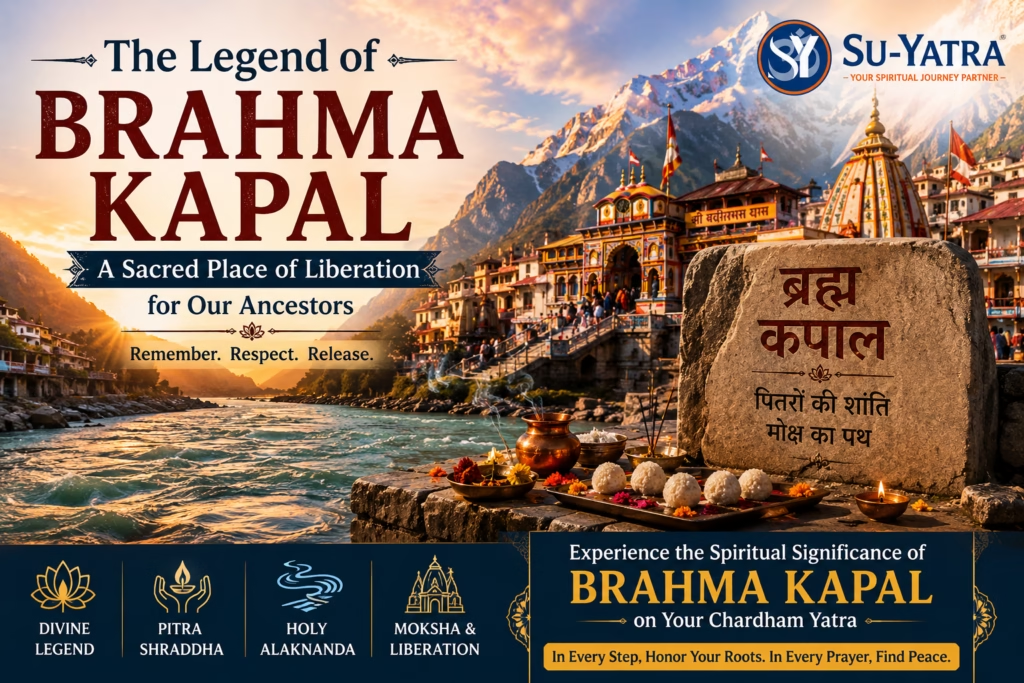
The Legend of Brahma Kapal-High in the Garhwal Himalayas, where the Alaknanda River flows beside the holy town of Badrinath, lies a sacred place known as Brahma Kapal. It is not a grand temple crowned with towering spires, nor is it surrounded by elaborate architecture. Instead, Brahma Kapal is a relatively simple stone platform near Badrinath Temple. Yet for countless Hindu families, it is one of the most spiritually significant places in the entire Char Dham pilgrimage.
Pilgrims visit Brahma Kapal to remember their ancestors and perform traditional rites such as Shraddha, Pind Daan and Tarpan. The Shri Badarinath Kedarnath Temple Committee identifies it as an important sacred site on the banks of the Alaknanda where rituals are offered for departed family members. The official Uttarakhand pilgrimage portal also recognises Brahma Kapal as a place associated with ancestral ceremonies.
However, the importance of Brahma Kapal does not arise only from the rituals practised there. Its sacred identity is rooted in powerful legends involving Lord Brahma, Lord Shiva, Lord Vishnu, sin, penance and liberation. These stories have been preserved through religious tradition and help explain why pilgrims consider Brahma Kapal a place where spiritual burdens may be released.
For travellers undertaking a thoughtfully planned Chardham Yatra Package, visiting Brahma Kapal can deepen the Badrinath experience. It transforms the pilgrimage from a journey centred only on receiving divine blessings into one that also honours family lineage, gratitude and the memory of previous generations.
Where Is Brahma Kapal?
Brahma Kapal is located beside the Alaknanda River in Badrinath, Uttarakhand, close to the famous Badrinath Temple. Badrinath itself is one of the four principal shrines of the Uttarakhand Char Dham pilgrimage, alongside Yamunotri, Gangotri and Kedarnath.
The site consists of a flat stone platform or ghat where priests guide families through ancestral ceremonies. Its position beside the fast-flowing river and beneath the surrounding Himalayan peaks creates a deeply reflective environment.
Badrinath Temple is situated amid the Nar and Narayan mountain ranges at an altitude of more than 3,000 metres, while the sacred Alaknanda flows nearby. Brahma Kapal forms part of this larger spiritual landscape, together with Tapt Kund, Narad Kund, Sheshnetra, Mata Murti Temple and Mana.
A conventional visitor may see Brahma Kapal as a small riverside ghat. A pilgrim, however, sees it as a meeting point between the living and the departed, between memory and liberation, and between human responsibility and divine grace.
Understanding the Meaning of “Brahma Kapal”
The word Brahma refers to Lord Brahma, the creator within the Hindu Trimurti, while kapal commonly means skull or the upper part of the head.
This name is closely connected with the most widely told legend of Brahma Kapal—the story of Lord Shiva carrying the severed fifth head of Brahma.
Different traditions narrate the details in slightly different ways. Some focus on Brahma’s pride, others on a disagreement between Brahma and Shiva, and still others emphasise the moral burden of Brahmahatya, or the sin associated with killing a Brahmin or divine creator figure.
These stories belong to Hindu sacred mythology rather than recorded history. Their purpose is not merely to describe an event but to communicate spiritual ideas about pride, responsibility, repentance and liberation.
The Legend of Brahma’s Fifth Head
According to a widely repeated Hindu legend, Lord Brahma originally possessed five heads. Four looked toward the four directions, while the fifth looked upward.
Over time, Brahma is said to have developed pride in his role as creator. In some versions of the story, the fifth head spoke arrogantly or behaved disrespectfully toward Lord Shiva. In other versions, Brahma falsely claimed superiority or failed to accept a divine truth.
Lord Shiva, representing the destruction of ego and illusion, became angered by Brahma’s pride. He cut off Brahma’s fifth head.
Although Shiva acted to destroy arrogance, the severed head became attached to his hand. Since Brahma was regarded as a creator deity and associated with sacred knowledge, the act burdened Shiva with the sin known as Brahmahatya.
The skull remained fixed to Shiva’s palm, and he could not free himself from it.
Thus began Shiva’s journey of penance.
Shiva as Bhikshatana
After the head of Brahma became attached to his hand, Lord Shiva is said to have wandered across the world as Bhikshatana, the divine mendicant.
In this form, Shiva travelled without royal possessions or outward glory. He carried Brahma’s skull as a begging bowl and sought freedom from the consequence of his action.
The image is spiritually powerful. Shiva, one of the highest deities in Hindu tradition, accepts the role of a wandering ascetic. He does not claim that his divine status places him above the moral order. Instead, he carries the visible symbol of his act and undergoes penance.
The legend therefore teaches that spiritual greatness does not mean avoiding responsibility. Even immense power must be accompanied by humility.
For ordinary people, the story offers a clear lesson: actions create consequences, and genuine purification begins when a person acknowledges those consequences rather than hiding from them.
The Skull Falls at Brahma Kapal
Lord Shiva is believed to have travelled through many sacred places, yet Brahma’s skull remained attached to his hand.
Eventually, he reached the holy region of Badrikashram, associated with Lord Vishnu and the meditation of Nara and Narayana. When Shiva arrived at the place now known as Brahma Kapal, the skull finally separated from his palm and fell to the ground.
The burden of Brahmahatya was removed, and Shiva was liberated from the consequence that had followed him.
Because Brahma’s kapal is believed to have fallen there, the place became known as Brahma Kapal.
This event forms the central spiritual foundation of the site. If even Lord Shiva received release there, devotees believe that prayers and ancestral ceremonies performed at Brahma Kapal carry extraordinary spiritual importance.
The story also explains why Brahma Kapal is considered a place of freedom from old burdens. It is associated not simply with death, but with release, purification and the ending of spiritual debt.
Another Tradition Connected with Lord Brahma
Official tourism information also preserves a tradition directly connecting Brahma Kapal with Lord Brahma and a sacred yagna. This illustrates that more than one devotional account is associated with the site.
In Indian pilgrimage traditions, sacred places often carry several overlapping stories. These accounts are not always intended to compete with one another. Instead, each one highlights a different aspect of the site’s religious meaning.
The Shiva legend explains the name “Brahma Kapal” and its association with liberation from sin. The traditions connected directly with Brahma emphasise creation, sacred ritual and divine presence.
Together, these stories give Brahma Kapal a complex spiritual identity.
Why Brahma Kapal Became a Place for Ancestral Rites
The legend of Shiva’s liberation created a strong association between Brahma Kapal and freedom from karmic burdens.
Over time, the site became an important place for performing ceremonies for deceased ancestors. Families visit to offer Pind Daan, Shraddha and Tarpan while praying for peace and spiritual liberation for departed souls.
The Shri Badarinath Kedarnath Temple Committee describes Brahma Kapal as a place where pilgrims pay homage to deceased family members and traditionally believe that rites performed there help the departed attain liberation from the cycle of birth and death.
This belief belongs to the spiritual framework of Hindu tradition and cannot be treated as a scientifically verifiable claim. Nevertheless, it has shaped the religious life of Badrinath for generations.
The logic of the tradition is deeply connected with the legend: a place where a divine being was freed from a burden became a place where families pray for the release of their ancestors.
The Meaning of Ancestral Gratitude
At Brahma Kapal, remembrance is not based only on sorrow. It is also an expression of gratitude.
Every human life is connected with previous generations. People inherit names, languages, customs, values, family memories and opportunities from those who came before them.
Yet modern life often encourages individuals to think of themselves as entirely self-made. Brahma Kapal offers a different perspective. It asks pilgrims to acknowledge that their lives are part of a much longer family story.
During ancestral rituals, the focus moves away from personal desires. The pilgrim is not simply asking for health, success or prosperity. Instead, the person pauses to remember parents, grandparents and earlier members of the family.
This act of remembrance can be emotionally powerful even for travellers who approach the ritual primarily as a cultural tradition.
A Chardham Yatra Package that includes sufficient time at Brahma Kapal allows families to experience this reflective side of the pilgrimage rather than reducing Badrinath to a brief temple stop.
Pind Daan at Brahma Kapal
Pind Daan is one of the principal ancestral rituals performed at Brahma Kapal.
During the ceremony, ritual offerings known as pinds are prepared according to the family’s religious tradition and the guidance of the priest. The exact ingredients and sequence may vary depending on regional custom, family lineage and the person for whom the ceremony is being performed.
The ritual generally includes a Sankalp, or sacred declaration of intention, followed by mantras, offerings and prayers for departed family members.
Families may be asked to provide the names of deceased ancestors and their gotra, where known. Water offerings known as Tarpan may also be performed.
The ceremony should ideally be conducted under the guidance of a knowledgeable Teerth Purohit rather than copied from generic online instructions. Hindu ancestral rites vary significantly across communities, and a priest can help the family follow the appropriate tradition.
Shraddha and Tarpan
Shraddha broadly refers to ancestral rites performed with faith and reverence. The word is connected with shraddha, meaning sincere faith.
Tarpan generally involves offering water while remembering ancestors and, depending on the tradition, other divine beings or sages.
Pind Daan, Shraddha and Tarpan are closely related, though they are not always identical. At Brahma Kapal, all three are associated with honouring departed souls.
The physical materials used in the ritual are important, but the intention behind them is even more significant. A ceremony performed mechanically may complete an external process, while one performed with gratitude and attention becomes a profound emotional and spiritual experience.
The Alaknanda River and the Symbolism of Flow
Brahma Kapal’s location beside the Alaknanda River contributes greatly to its spiritual atmosphere.
Rivers are sacred within Hindu tradition because they represent purification, continuity and movement. Water does not remain fixed. It flows onward, just as human life passes from one generation to another.
When ancestral rites are performed beside the Alaknanda, the river becomes a natural symbol of impermanence.
The person performing the ceremony may recognise that every generation eventually passes, but its influence continues to flow through descendants.
The sound of the river also creates a solemn environment. Unlike a silent room, the flowing Alaknanda constantly reminds pilgrims that life continues even through grief and loss.
Pilgrims should honour the sacred river by avoiding plastic, packaging and non-biodegradable waste. Ritual materials should be handled according to the instructions of local priests and authorities.
Brahma Kapal and Lord Vishnu
Although the most famous legend of Brahma Kapal centres on Shiva and Brahma, the site is situated within Badrikashram, the sacred domain of Lord Vishnu.
Badrinath Temple is dedicated to Lord Vishnu in the form of Badrinarayan. The wider region is associated with meditation, penance and liberation. Official temple information describes the sacred history of Badrinath and its association with Vishnu, Nara-Narayana and several related holy places.
In the legend, Shiva’s release occurs only after he reaches this spiritually powerful region.
This reflects an important feature of Hindu tradition: the sacred stories of Brahma, Vishnu and Shiva often overlap. The deities are not always presented as isolated figures. Their legends interact to teach larger truths about creation, preservation, destruction, ego and liberation.
Brahma creates. Shiva destroys pride. Vishnu’s sacred region provides the setting for release.
The story therefore unites the three principal divine functions within a single pilgrimage tradition.
What the Legend Teaches About Ego
One of the clearest lessons in the Brahma Kapal legend concerns ego.
Brahma’s fifth head is often interpreted as a symbol of pride. The head that rises above the others represents an ego that refuses to remain balanced.
Shiva’s act of removing the head can therefore be understood symbolically as the destruction of arrogance.
However, the story does not end with punishment. Shiva must also carry the consequence of his own violent action.
This creates a balanced moral lesson. Pride must be challenged, but even an action taken against wrongdoing can create consequences if it is performed through anger or force.
The legend does not present morality as simplistic. It shows that human and divine actions exist within a web of responsibility.
The Importance of Repentance
Shiva’s wandering as Bhikshatana represents repentance and purification.
He does not solve the problem through greater power. He becomes a mendicant.
This reversal is spiritually significant. The lord of destruction, feared and worshipped across the universe, accepts humility.
Repentance in this context is not humiliation imposed by others. It is the willingness to transform oneself.
The story teaches that release does not come from denying the past. It comes from facing it, carrying its lessons and gradually becoming free from its hold.
For pilgrims, Brahma Kapal may therefore symbolise more than ancestral rituals. It can also become a place to reflect upon personal guilt, unresolved relationships and the need for forgiveness.
Liberation as Letting Go
The moment when Brahma’s skull falls from Shiva’s hand represents liberation.
For a long time, Shiva carries something that does not naturally belong to him. It remains attached because of an unresolved consequence.
Human beings also carry invisible burdens: regret, anger, grief, pride and memories of past mistakes.
The Brahma Kapal legend suggests that spiritual freedom is not always achieved by adding more practices or possessions. Sometimes it comes through letting go.
The skull falling is therefore both a mythological event and a psychological symbol.
At Brahma Kapal, families pray for the release of ancestors, but the living may also experience a sense of emotional release. Speaking the names of departed relatives, offering prayers and completing a long-delayed ceremony can bring peace to family members.
Brahma Kapal During a Chardham Yatra Package
The Uttarakhand Char Dham journey traditionally includes Yamunotri, Gangotri, Kedarnath and Badrinath.
Each shrine carries a distinctive spiritual atmosphere. Yamunotri and Gangotri are associated with sacred rivers, Kedarnath with Lord Shiva, and Badrinath with Lord Vishnu.
Brahma Kapal adds the theme of ancestral remembrance to the pilgrimage.
A well-planned Chardham Yatra Package should ideally provide enough time at Badrinath for pilgrims to visit associated sacred sites rather than departing immediately after darshan.
A balanced Badrinath visit may include Tapt Kund, Badrinath Temple, Brahma Kapal and, depending on time and conditions, nearby places such as Mana, Mata Murti Temple, Vyas Gufa and Bheem Pul.
Travellers intending to conduct Pind Daan should inform their travel organiser beforehand. An ancestral ceremony may require more time than a casual visit, particularly during busy pilgrimage periods.
Brahma Kapal for Families
A visit to Brahma Kapal can become an important family experience.
Elder members may share the names and stories of ancestors with younger generations. Children may learn about grandparents or great-grandparents they never had an opportunity to meet.
In this way, the ritual preserves family history.
Families often maintain photographs and documents, but ceremonies create another form of memory. They allow younger people to understand that ancestors are not simply names in a family tree. They were real individuals whose decisions shaped the lives of later generations.
A Chardham Yatra Package undertaken together can therefore strengthen family relationships while connecting travellers with a shared spiritual and cultural heritage.
Etiquette at Brahma Kapal
Brahma Kapal is an active sacred site where families may be grieving or performing deeply personal ceremonies.
Visitors should maintain silence and avoid disturbing ongoing rituals. Photography of families, priests or ceremonies should never be undertaken without permission.
Pilgrims should dress modestly and behave respectfully. The site should not be treated like a backdrop for casual social-media content.
Visitors who are not performing a ritual may observe the Alaknanda, offer a quiet prayer and reflect without entering the private space of another family’s ceremony.
Respectful behaviour preserves the sanctity of Brahma Kapal for everyone.
Practical Preparation for a Visit
Badrinath is situated at high altitude, and temperatures may remain cold even during the pilgrimage season. Travellers should carry warm layers, comfortable footwear and rain protection.
Those intending to perform ancestral rites should collect the relevant names, dates and gotra information before beginning their journey, where available.
They should also consult their family priest or a recognised priest at Brahma Kapal regarding the appropriate ritual.
Char Dham registration and current travel advisories should be checked through official Uttarakhand sources. The pilgrimage registration portal identifies Badrinath’s altitude and includes Brahma Kapal among its significant religious locations.
Since mountain weather and road conditions can change, travellers should maintain flexibility rather than relying on an extremely tight itinerary.
Why the Legend Still Matters Today
The legend of Brahma Kapal remains relevant because its central themes are timeless.
Pride remains a human weakness. Actions still create consequences. People continue to struggle with guilt, grief and unresolved memories. Families still feel the need to honour those who have passed away.
The story offers a path through these experiences.
It teaches that pride can be removed, but the process requires humility. It teaches that responsibility cannot be escaped through status or power. It teaches that sincere penance can lead to release.
Most importantly, it teaches that no burden needs to remain attached forever.
This is why Brahma Kapal continues to attract pilgrims. They come not only because tradition tells them to visit, but because the site speaks to fundamental human experiences—loss, responsibility, remembrance and hope.
Frequently Asked Questions
What is the main legend of Brahma Kapal?
According to a widely followed tradition, Lord Shiva severed the fifth head of Lord Brahma. The skull became attached to Shiva’s hand because of the sin associated with the act. It finally fell away when Shiva reached the sacred region of Badrinath, and the place became known as Brahma Kapal.
Why is Pind Daan performed at Brahma Kapal?
Devotees believe that because Lord Shiva attained freedom from his burden at this location, ancestral rites performed here carry special spiritual importance. Families visit to pray for peace and liberation for departed ancestors.
Where is Brahma Kapal located?
Brahma Kapal is situated beside the Alaknanda River near Badrinath Temple in Uttarakhand.
Is the legend historically proven?
The story belongs to Hindu mythology and religious tradition. It should be understood as a sacred narrative conveying spiritual meaning rather than as a historically verified event.
Can Brahma Kapal be included in a Chardham Yatra Package?
Yes. It is located near Badrinath Temple and can be included in the Badrinath portion of a Chardham Yatra Package. Families planning ancestral rituals should reserve sufficient time and make arrangements in advance.
Do visitors have to perform Pind Daan?
No. Visitors may come to offer prayers, learn about the legend or quietly experience the sacred surroundings. Pind Daan is performed according to family needs and religious traditions.
Conclusion-The legend of Brahma Kapal
The legend of Brahma Kapal is a powerful story of pride, consequence, repentance and liberation.
According to sacred tradition, Lord Shiva severed the fifth head of Brahma and was then compelled to carry the skull as a reminder of the consequence of his action. He wandered as a mendicant until he reached the holy region of Badrinath, where the skull finally fell from his hand.
That moment transformed the place into Brahma Kapal—a sacred site associated with release from spiritual burdens.
Today, families gather beside the Alaknanda to perform Pind Daan, Shraddha and Tarpan for departed ancestors. They come with faith that prayers offered here may bring peace to those who have passed away. Official temple and pilgrimage sources continue to identify Brahma Kapal as one of Badrinath’s principal locations for ancestral rites.
Yet the deeper meaning of Brahma Kapal extends beyond ritual. It reminds pilgrims to honour their lineage, accept responsibility for their actions and release the pride or pain they may be carrying.
Including Brahma Kapal in a Chardham Yatra Package can therefore make the Badrinath journey far more meaningful. The traveller does not simply stand before a deity and ask for blessings. The traveller also pauses beside the sacred river, remembers previous generations and reflects upon the spiritual journey from burden to freedom.
In the silence of the Himalayas and the endless movement of the Alaknanda, Brahma Kapal offers a timeless message: no burden is permanent when it is met with humility, faith and sincere transformation.


