
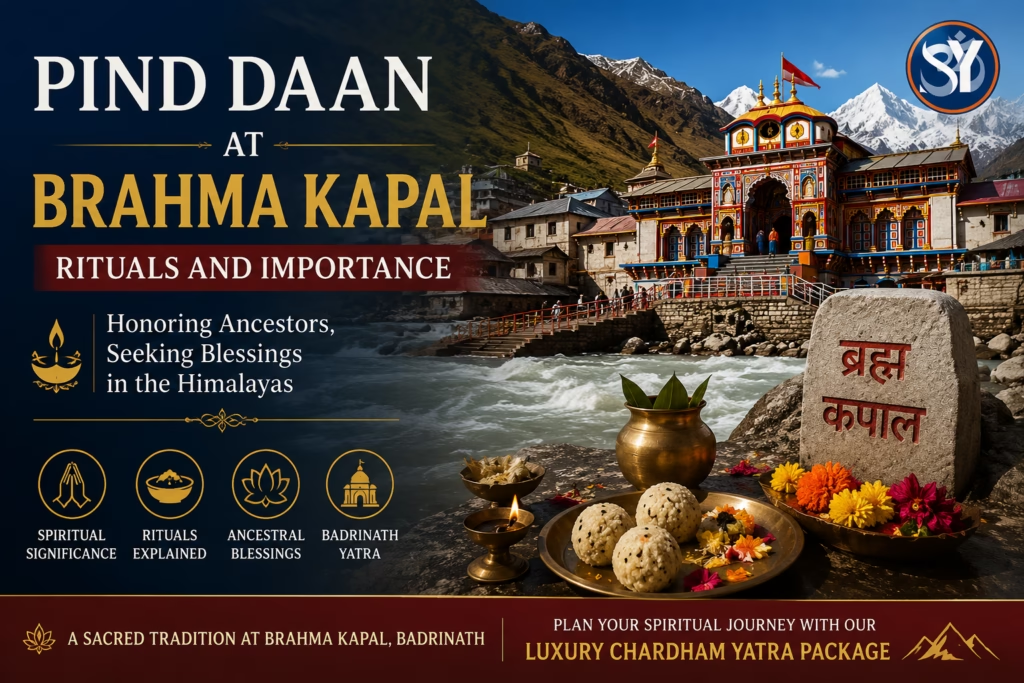
Pind Daan at Brahma Kapal-The sacred journey to Badrinath Dham is much more than offering prayers at the famous Badrinath Temple. For many Hindu families, the pilgrimage also becomes an opportunity to remember their ancestors, express gratitude to previous generations and perform traditional rites for departed family members. One of the most revered places for these ancestral rituals is Brahma Kapal, a sacred ghat situated on the banks of the Alaknanda River near Badrinath Temple.
Brahma Kapal holds a special place in Hindu pilgrimage traditions because devotees come here to perform Pind Daan, Shraddha and Tarpan for their ancestors. The Shri Badarinath Kedarnath Temple Committee describes Brahma Kapal as a ghat near Badrinath Temple where Hindus perform rituals and offer Shraddha to departed ancestors. Uttarakhand Tourism similarly identifies it as a platform on the Alaknanda where rites for deceased ancestors are traditionally performed.
For pilgrims travelling through a thoughtfully planned Luxury Chardham Yatra Package, a visit to Brahma Kapal can add an especially meaningful dimension to the Badrinath experience. While comfortable transport, suitable accommodation and organised travel arrangements make the physical journey easier, places such as Brahma Kapal remind travellers that the deeper purpose of a Char Dham pilgrimage lies in devotion, gratitude and spiritual reflection.
What Is Brahma Kapal?
Brahma Kapal is a sacred site located in the vicinity of Badrinath Temple on the banks of the Alaknanda River. Unlike the magnificent temple architecture of Badrinath, Brahma Kapal is comparatively simple. Its importance comes not from grandeur but from the centuries-old religious traditions associated with the place.
The official Shri Badarinath Kedarnath Temple Committee describes Brahma Kapal as a flat ghat or platform beside the Alaknanda where pilgrims honour departed souls and perform Shraddha. The Government of India’s Incredible India portal likewise describes it as a sacred location where devotees perform Tarpan and Pind Daan for their ancestors.
Standing beside the rapidly flowing Alaknanda with the Himalayan mountains surrounding Badrinath, pilgrims often experience a powerful contrast. The river is constantly moving forward, while the rituals performed beside it encourage people to pause and remember those who came before them.
This combination of nature, faith and remembrance gives Brahma Kapal its unique spiritual character.
What Is Pind Daan?
Pind Daan is a traditional Hindu ancestral rite performed in memory of deceased family members. The word “pind” commonly refers to a ritual offering prepared during the ceremony, while “daan” means offering or giving.
The exact procedure can vary according to family tradition, regional custom and the guidance of the priest conducting the ceremony. The ritual is normally connected with Shraddha—the expression of reverence toward one’s ancestors—and Tarpan, in which water is ritually offered.
At Brahma Kapal, pilgrims perform these rites with the intention of honouring their ancestors and praying for peace for departed souls. Incredible India specifically notes that both Tarpan and Pind Daan are performed here as ancestral rites.
Pind Daan should therefore not be understood as merely completing a religious formality. At an emotional level, it can become a moment of remembrance. Families recall parents, grandparents and previous generations and acknowledge that their own lives are connected to the sacrifices and experiences of those who came before them.
For someone undertaking a Luxury Chardham Yatra Package, allocating adequate time at Badrinath for Brahma Kapal can therefore be far more meaningful than rushing through the destination only for sightseeing.
Why Is Brahma Kapal Considered Sacred?
The religious significance of Brahma Kapal is closely associated with Hindu sacred traditions surrounding Lord Brahma, Lord Vishnu and the holy region of Badrinath.
Different devotional traditions tell the story of Brahma Kapal in somewhat different ways. The Incredible India portal records a tradition connecting the site with Lord Brahma and a yagna performed there. Other widely repeated regional traditions connect the name “Brahma Kapal” with Lord Shiva and Brahma’s head. These stories belong to sacred mythology and are best understood as religious traditions rather than historical events.
The Shri Badarinath Kedarnath Temple Committee notes the traditional belief that performing Shraddha rites for deceased family members at Brahma Kapal helps the departed attain liberation from the cycle of birth and death. This is a matter of Hindu religious belief rather than something that can be scientifically demonstrated, but it explains why generations of pilgrims have considered the site exceptionally sacred.
The significance of Brahma Kapal is therefore inseparable from the larger sacred landscape of Badrinath. Here, worship of Lord Vishnu at Badrinath Temple and remembrance of one’s ancestors at Brahma Kapal become interconnected parts of the pilgrimage.
Pind Daan and the Hindu Tradition of Remembering Ancestors
Respect for ancestors is an important theme within Hindu religious life. A human being is not considered completely independent of the generations that came before. Family lineage, culture, values, knowledge and opportunities are all inherited in different ways.
Shraddha and Pind Daan provide a ritual expression of gratitude toward those previous generations.
The ceremony asks the pilgrim to stop thinking only about personal wishes. Instead of praying exclusively for success, health or prosperity, the devotee remembers people who are no longer physically present.
This makes Pind Daan an unusually reflective part of pilgrimage.
During a conventional holiday, travellers generally focus on what they can see, photograph or experience. During a sacred journey, the focus shifts toward what can be remembered, understood and spiritually offered.
This is one of the reasons a Luxury Chardham Yatra Package should ideally provide sufficient time for pilgrims who wish to perform traditional ceremonies instead of treating Badrinath only as a brief stop on an itinerary.
The Spiritual Importance of Pind Daan at Brahma Kapal
According to Hindu belief, ancestral rituals performed with sincerity help honour the departed and express the continuing bond between generations. At Brahma Kapal, these ceremonies gain additional importance because of the sanctity traditionally attached to Badrinath and the Alaknanda River.
The Badarinath Kedarnath Temple Committee explicitly identifies Brahma Kapal as a place where pilgrims pay homage to deceased ancestors.
Yet the importance of Pind Daan can be understood at more than one level.
Spiritually, devotees pray for the peace and liberation of their ancestors.
Emotionally, families receive an opportunity to remember people whom they have lost.
Culturally, the ritual connects younger generations to traditions maintained within families for centuries.
Philosophically, it reminds pilgrims of the temporary nature of human life.
A person standing beside the Alaknanda is reminded that generations arrive and depart just as the water continues flowing through the mountains. What ultimately remains is the influence people leave through their actions, relationships and values.
Rituals Traditionally Associated with Pind Daan at Brahma Kapal
The precise ritual should be performed under the guidance of an authorised or traditionally recognised local Teerth Purohit because procedures can differ depending on family circumstances and customary practice.
A ceremony generally begins with a Sankalp, or statement of sacred intention. During this stage, the pilgrim identifies the purpose for which the ritual is being performed. Details such as family lineage or gotra and the names of ancestors may be requested by the priest depending on the tradition being followed.
The priest then guides the family through prayers and ancestral offerings. Ritual offerings commonly associated with Shraddha traditions may be prepared according to the prescribed procedure. Water offerings or Tarpan may also form part of the ceremony.
Incredible India confirms that both Pind Daan and Tarpan are among the principal ancestral rites performed at Brahma Kapal.
Mantras are recited during the ceremony while prayers are offered for departed family members. The concluding stages may involve final offerings, prayers and dakshina according to customary practice.
Travellers should avoid relying solely on generic internet instructions for a personal Shraddha ceremony. Family traditions vary considerably, and the appropriate procedure may depend on the person for whom the ritual is being performed. Speaking with a knowledgeable priest before beginning the ceremony is the most respectful approach.
What Should Pilgrims Carry for Pind Daan?
It is advisable to discuss ritual requirements with the priest in advance rather than purchasing items independently. The priest can explain what is needed according to the ceremony being performed.
Pilgrims may also want to keep the full names of deceased family members available and, where known, information regarding their gotra or family lineage. Elder family members can often help provide these details before the journey.
Simple and modest clothing is appropriate at Brahma Kapal. Since the site is in a high-altitude Himalayan environment, pilgrims should simultaneously dress for local weather conditions.
A well-organised Luxury Chardham Yatra Package can be especially useful for families travelling with senior citizens because comfortable transportation, convenient accommodation and a less hurried schedule allow them to concentrate on the ritual rather than logistical difficulties.
Luxury in a spiritual journey should not mean extravagance at the sacred site. Rather, it can mean removing unnecessary travel stress so that pilgrims have greater time and mental space for worship.
Brahma Kapal and the Alaknanda River
The location of Brahma Kapal beside the Alaknanda contributes greatly to the atmosphere of the ceremony. Official tourism sources specifically identify the site as being on the riverbank.
Rivers occupy an important position in Hindu sacred geography. Flowing water is frequently associated with purification, continuity and the movement of life.
At Brahma Kapal, the Alaknanda becomes the natural background to ceremonies concerned with memory, mortality and liberation. The sound of the rushing river, the mountain air and the dramatic Himalayan surroundings make the experience profoundly different from performing the same act in an ordinary urban environment.
Pilgrims should, however, respect both the sanctity and ecology of the river. Ritual materials should be handled according to local instructions, and plastic, packaging or other waste should never be thrown into the Alaknanda.
Protecting a sacred river is itself a form of respect.
Brahma Kapal and Badrinath Temple
Brahma Kapal and Badrinath Temple should not be viewed as unrelated attractions.
Badrinath is one of the Uttarakhand Char Dham shrines and is dedicated to Lord Vishnu. The official Uttarakhand pilgrimage portal also identifies Brahma Kapal as one of the significant locations associated with Badrinath where rituals for ancestors are conducted.
Pilgrims may therefore combine darshan at Badrinath Temple with a visit to Brahma Kapal according to their spiritual requirements and the advice of local priests.
For someone booking a Luxury Chardham Yatra Package, Badrinath should ideally be experienced at a peaceful pace. The destination includes not only the main temple but also Tapt Kund, Brahma Kapal and other sacred sites in the surrounding area.
A rushed arrival followed immediately by departure may complete a travel schedule, but it may not provide the reflective experience that a pilgrimage deserves.
The Difference Between Pind Daan, Shraddha and Tarpan
These terms are sometimes used together, but they are not always identical.
Shraddha broadly refers to rites performed with reverence for one’s ancestors.
Pind Daan refers to the offering of ritual pinds as part of ancestral rites.
Tarpan involves ritual water offerings made in honour of ancestors and, depending on the tradition, other sacred beings.
The exact relationship between these practices varies across Hindu traditions and family customs. At Brahma Kapal, however, ancestral worship remains the central purpose of all three.
Rather than worrying excessively about terminology, pilgrims should follow their family tradition and the guidance of the priest conducting the ritual.
Why Brahma Kapal Is Important During Chardham Yatra
The Char Dham Yatra of Uttarakhand takes pilgrims through Yamunotri, Gangotri, Kedarnath and Badrinath. Each destination offers a different expression of devotion.
By the time pilgrims arrive at Badrinath, they have journeyed through rivers, valleys, temples and some of the most dramatic landscapes of the Himalayas. Brahma Kapal adds yet another dimension: remembrance.
A pilgrimage ordinarily begins with personal intentions. People may pray for health, peace, success or spiritual development. At Brahma Kapal, however, attention turns towards previous generations.
In this sense, Pind Daan transforms the journey from “What blessings do I seek?” into “What gratitude do I owe?”
That shift is deeply significant.
A carefully designed Luxury Chardham Yatra Package should therefore balance comfort with spiritual depth. Comfortable hotels and vehicles are helpful, but an authentic pilgrimage should also create opportunities to understand the stories, rituals and traditions connected with each Dham.
Pind Daan for Families and Senior Citizens
Many families undertake the Char Dham pilgrimage together, and ancestral rites at Brahma Kapal can become a shared spiritual experience across generations.
Grandparents may explain the names and stories of previous family members to younger travellers. Children and grandchildren may learn why ancestors are remembered and how traditions are passed from one generation to the next.
This gives Pind Daan an important cultural dimension.
For elderly travellers, however, altitude, cold weather, walking and changing Himalayan conditions can make the journey demanding. Badrinath stands at a high elevation, and travellers should follow appropriate health and local travel guidance.
This is where a Luxury Chardham Yatra Package can provide practical value through planned transport, conveniently located accommodation, adequate rest and a flexible itinerary.
Comfort should enable devotion rather than replace it.
Etiquette While Visiting Brahma Kapal
Brahma Kapal is an active religious site, not simply a tourist attraction. Visitors should therefore maintain silence and behave respectfully while ceremonies are taking place.
Photography of families performing private ancestral rituals should be avoided unless explicit permission has been given. Pilgrims experiencing grief or remembrance deserve privacy.
Visitors should also avoid crowding priests or ceremonies simply to observe them.
Cleanliness is equally important. The Alaknanda and surrounding Himalayan environment should not be polluted by discarded plastic, food packaging or ritual waste. Follow local directions regarding where ceremonial materials should be placed.
Respectful conduct is one of the simplest ways of honouring the spiritual importance of the site.
The Deeper Meaning of Pind Daan
The deepest meaning of Pind Daan cannot be reduced to completing a ritual and expecting a particular reward.
At its heart, it is an acknowledgement that life is interconnected.
None of us exists entirely because of our own efforts. We inherit language, culture, values, family experiences and opportunities from generations before us. Even when family relationships were imperfect, remembering previous generations can help us understand our own place in a much longer human story.
Brahma Kapal turns this understanding into a physical pilgrimage.
The devotee travels hundreds or thousands of kilometres into the Himalayas, reaches the banks of the Alaknanda and pauses to remember people who are no longer able to make that journey themselves.
That act of remembrance is itself powerful.
Planning Brahma Kapal with a Luxury Chardham Yatra Package
Travellers specifically intending to perform Pind Daan should inform their travel planner before departure. Adequate time should be reserved at Badrinath instead of keeping an extremely tight sightseeing schedule.
Families may also wish to collect necessary ancestral information before beginning the Char Dham Yatra and clarify ritual requirements with the appropriate priest.
A good Luxury Chardham Yatra Package can arrange the broader journey—transportation, comfortable stays, route planning and appropriate time allocation—while the sacred ceremony itself should remain guided by qualified religious practitioners and the family’s traditional customs.
This combination allows pilgrims to experience comfort without losing the authenticity and seriousness of the pilgrimage.
Conclusion-Pind Daan at Brahma Kapal
Pind Daan at Brahma Kapal is one of the most meaningful ancestral traditions associated with Badrinath Dham. Situated beside the sacred Alaknanda River near Badrinath Temple, Brahma Kapal has long been a place where Hindu pilgrims perform Shraddha, Tarpan and Pind Daan in remembrance of departed family members. Official temple and tourism sources continue to identify ancestral rites as the central religious significance of the site.
For devotees, the ritual represents much more than tradition. It becomes an expression of gratitude, remembrance and prayer. It reminds us that pilgrimage is not always about asking the Divine for something; sometimes it is about remembering those whose lives made our own possible.
Including Brahma Kapal in a Luxury Chardham Yatra Package can therefore make the Badrinath experience spiritually richer. Comfortable travel may ease the outward journey, but the moments spent beside the Alaknanda encourage an inward journey—a journey into family memory, humility and gratitude.
Amid the towering Himalayan peaks and the continuous sound of the sacred river, Brahma Kapal gives pilgrims an opportunity to pause, remember their ancestors and reflect upon one of life’s most timeless truths: generations may pass, but love, gratitude and remembrance continue to flow.


