
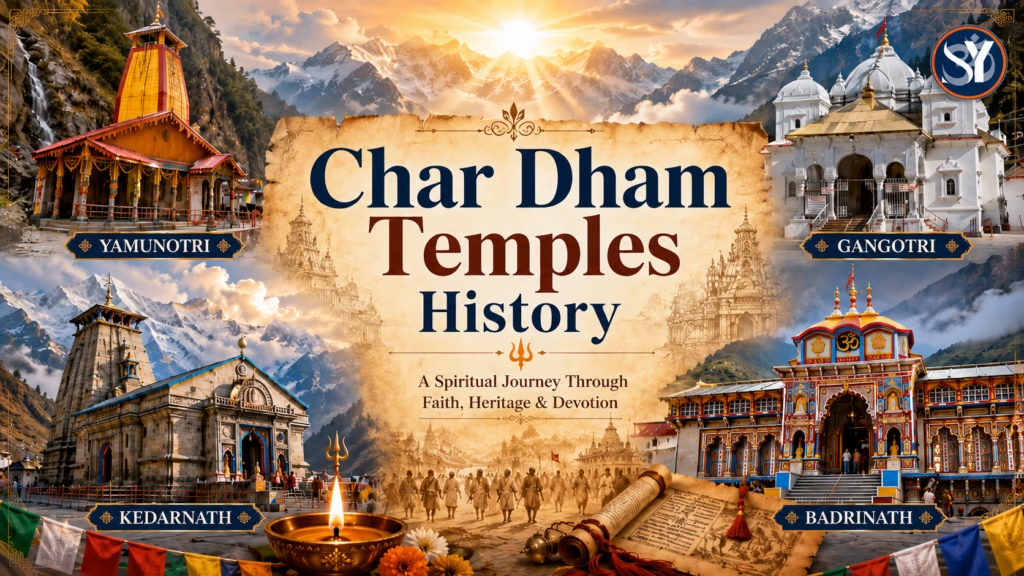
Char Dham Temples History-The Char Dham Yatra of Uttarakhand is one of the most revered pilgrimage journeys in India. It brings devotees to four sacred Himalayan shrines—Yamunotri, Gangotri, Kedarnath and Badrinath. Each temple is associated with a different divine presence and represents a distinct spiritual theme. Yamunotri honours Goddess Yamuna, Gangotri is dedicated to Goddess Ganga, Kedarnath is one of the most important shrines of Lord Shiva and Badrinath is dedicated to Lord Vishnu in the form of Badrinarayan.
Together, these four destinations form the Himalayan Char Dham, also popularly known as the Chota Char Dham. The traditional journey begins at Yamunotri, moves eastward to Gangotri and Kedarnath, and concludes at Badrinath. Uttarakhand Tourism describes this clockwise sequence as the customary order of pilgrimage.
The history of the Char Dham temples cannot be understood only through construction dates. These sacred places existed as pilgrimage landscapes, river sources, meditation centres and mythological locations long before the present temple buildings were constructed. Their stories combine ancient scripture, regional traditions, royal patronage, the work of priests, the influence of Adi Shankaracharya and the faith of generations of Himalayan communities.
A well-planned Chardham Yatra Package allows pilgrims to visit all four shrines conveniently, but understanding their historical and spiritual development makes the journey far more meaningful. Every temple stands not merely as a religious structure but as a living link between mythology, history, nature and devotion.
Understanding the Meaning of Char Dham
The word “Char” means four, while “Dham” refers to a sacred dwelling or pilgrimage destination. In Uttarakhand, the four Dhams are Yamunotri, Gangotri, Kedarnath and Badrinath. These high-altitude shrines usually remain accessible only during the warmer months because heavy snowfall closes the upper Himalayan routes during winter.
The Himalayan Char Dham should be distinguished from the four major all-India Dhams—Badrinath, Dwarka, Puri and Rameswaram—which are widely associated with Adi Shankaracharya’s vision of spiritual unity across India.
Badrinath belongs to both traditions. It is one of Uttarakhand’s four Himalayan Dhams and one of the four major Dhams of India.
The modern Char Dham circuit developed gradually as routes improved and the four shrines became linked within an organised pilgrimage journey. However, each destination had an independent sacred identity long before travellers began visiting all four as one package.
This is why the history of a Chardham Yatra Package is really the combined history of four different pilgrimage traditions.
The Sacred Geography Behind the Temples
The Char Dham temples stand near the sources or upper valleys of four important Himalayan rivers. Yamunotri is connected with the Yamuna, Gangotri with the Bhagirathi-Ganga, Kedarnath with the Mandakini and Badrinath with the Alaknanda.
In Indian religious tradition, rivers, glaciers, mountains and forests are not viewed as lifeless surroundings. They are treated as manifestations of divine energy.
The location of each temple therefore matters as much as its architecture.
Pilgrims do not merely enter a building and offer prayers. They travel through the river valley associated with the deity, experience the harshness of the mountain environment and approach a shrine that appears to have emerged from the sacred landscape itself.
This connection between temple and nature is one reason the Char Dham pilgrimage has retained its spiritual power despite modern roads, hotels and transport facilities.
History of Yamunotri Temple
Yamunotri is traditionally the first destination in the Char Dham circuit. The temple stands in a narrow Himalayan gorge close to the source region of the Yamuna River and is dedicated to Goddess Yamuna. Uttarakhand Tourism places the temple at an altitude of approximately 3,233 metres and describes it as the starting point of the Char Dham Yatra.
The physical source of the Yamuna lies higher in the mountains near the Champasar or Yamunotri Glacier area, but the present temple provides an accessible place where devotees can worship the river goddess.
Goddess Yamuna in Hindu Tradition
Yamuna is traditionally described as the daughter of Surya, the Sun God, and the sister of Yama, the deity associated with death and justice. This relationship gives Yamunotri a special spiritual meaning.
Devotees believe that worshipping Yamuna and bathing in her sacred waters may help remove the fear of untimely death. This is a matter of religious faith rather than a historical or scientific claim, but it remains central to Yamunotri’s devotional identity.
The river is also known as Kalindi and later becomes deeply associated with Lord Krishna’s life in Mathura and Vrindavan. The pilgrimage to Yamunotri therefore takes devotees to the Himalayan origin of a river that flows through several major centres of Krishna devotion.
Construction and Reconstruction of Yamunotri Temple
The history of the present Yamunotri Temple includes repeated construction and repair because the upper Himalayan region is vulnerable to snow, landslides, earthquakes and severe weather.
Uttarakhand Tourism states that the temple was built in 1839 and rebuilt during the nineteenth century. Another official state tourism itinerary attributes the temple’s construction to Maharaja Pratap Shah of Tehri Garhwal.
Historical accounts of Himalayan temples sometimes differ regarding exact dates and rulers because older structures were repeatedly damaged and rebuilt. It is therefore more accurate to understand the present temple as the result of several phases of royal patronage, local devotion and reconstruction.
The temple’s continued survival reflects the commitment of the rulers of Tehri Garhwal, priests, residents of nearby villages and generations of pilgrims.
Surya Kund and Divya Shila
The history of Yamunotri is inseparable from its natural hot springs. Surya Kund, located near the temple, is used by devotees to prepare rice or potatoes as a sacred offering.
Before entering the temple, pilgrims traditionally offer prayers at Divya Shila, a sacred stone situated near the hot spring.
These practices demonstrate that the sacred centre of Yamunotri includes not only the temple building but also the river, hot springs, rocks and surrounding mountain landscape. Uttarakhand Tourism specifically identifies Surya Kund, Gauri Kund and Divya Shila as important parts of the Yamunotri pilgrimage experience.
The Winter Tradition of Yamunotri
During winter, heavy snowfall makes the Yamunotri region inaccessible. The worship of Goddess Yamuna continues in the lower village of Kharsali.
This seasonal movement of the deity reflects an important characteristic of Himalayan temple culture. The physical shrine may close, but worship does not stop. The deity’s winter seat allows religious traditions to continue throughout the year.
For travellers booking a Chardham Yatra Package, Yamunotri is usually the first experience of this uniquely Himalayan combination of temple worship, trekking and living village traditions.
History of Gangotri Temple
Gangotri is the second destination of the traditional Char Dham journey. The temple is dedicated to Goddess Ganga and stands in the Uttarkashi district at an altitude of approximately 3,415 metres.
The Bhagirathi River flows beside the temple. The river is known as Bhagirathi in its upper course and acquires the name Ganga after meeting the Alaknanda at Devprayag.
The Legend of King Bhagiratha
The sacred history of Gangotri is rooted in the story of King Bhagiratha.
According to Hindu tradition, Bhagiratha undertook severe penance to bring the celestial Ganga to earth so that the souls of his ancestors could attain liberation. Ganga agreed to descend, but the force of her fall was believed to be too powerful for the earth to withstand.
Lord Shiva received the river in his matted hair and released her gradually, allowing her waters to flow safely across the land.
Gangotri therefore represents perseverance, ancestral responsibility and divine compassion. Uttarakhand Tourism describes the descent of Ganga through Shiva’s locks as the central legend associated with the destination.
The Temple and Its Royal Patronage
The present Gangotri Temple is generally associated with the early nineteenth century. It is widely credited to the Gorkha commander Amar Singh Thapa, who is believed to have constructed or rebuilt the shrine during the period of Gorkha influence in the region.
The temple was later renovated under royal patronage, often associated with the rulers of Jaipur.
As with many ancient pilgrimage sites, the sacred importance of Gangotri predates the current temple building. Devotees, ascetics and local communities worshipped the river and visited the upper Bhagirathi valley long before the present stone structure was created.
The temple therefore formalised an already ancient river pilgrimage.
Architecture of Gangotri Temple
Gangotri Temple is built in a simple Himalayan style using light-coloured stone. Its modest structure contrasts with the immense mountains surrounding it.
This simplicity is significant. The temple does not attempt to overpower the natural landscape. Instead, it appears as a sacred point beside the river, with the Himalayas forming the larger divine setting.
The sanctum houses the image of Goddess Ganga, while other sacred figures connected with the river and local tradition are also worshipped.
Gaumukh and the Glacier
Gangotri Temple is not located at the exact geographical source of the river. Gaumukh, the snout of the Gangotri Glacier, lies approximately 19 kilometres from Gangotri and is reached by trekking.
This distinction between the temple and the glacier reflects the practical development of pilgrimage. The temple provides a place accessible to a larger number of devotees, while Gaumukh remains a more demanding destination for trekkers and ascetics.
The history of Gangotri is therefore also the history of humanity’s relationship with the glacier, the river and the sacred Himalayan environment.
Gangotri’s Winter Seat
When the Gangotri Temple closes for winter, the idol of Goddess Ganga is ceremonially moved to Mukhba village. Worship continues there until the upper shrine reopens.
This seasonal tradition has helped preserve continuity of worship despite the difficult climate.
For pilgrims travelling with a Chardham Yatra Package, Gangotri offers a powerful combination of temple history, river mythology and Himalayan scenery.
History of Kedarnath Temple
Kedarnath is one of India’s most revered Shiva temples. It forms part of the Uttarakhand Char Dham, the Panch Kedar group and the twelve Jyotirlinga tradition.
The Shri Badarinath Kedarnath Temple Committee identifies Kedarnath as one of the twelve Jyotirlingas and describes it as a temple dedicated to Lord Shiva on the banks of the Mandakini River.
Situated at an altitude of more than 3,500 metres and surrounded by snow-covered peaks, the temple stands in one of the most dramatic locations of the Char Dham journey.
The Pandavas and the Origin Legend
The most famous tradition associated with Kedarnath begins after the Mahabharata war.
The Pandavas, burdened by the deaths caused during the conflict, are believed to have sought Lord Shiva’s forgiveness. Shiva did not wish to meet them immediately and took the form of a buffalo.
When the Pandavas recognised him, Shiva attempted to disappear into the earth. Bhima tried to hold the buffalo, but the divine form vanished, leaving its hump visible at Kedarnath.
The conical rock worshipped inside the temple is traditionally identified with that hump and is revered as Lord Shiva in his Sadashiva form. The official temple committee preserves this account as the principal origin legend of Kedarnath.
Other parts of Shiva’s buffalo form are associated with Tungnath, Rudranath, Madhyamaheshwar and Kalpeshwar, together forming the Panch Kedar pilgrimage.
The Early Temple and Adi Shankaracharya
The Shri Badarinath Kedarnath Temple Committee states that the present temple is traditionally connected with Adi Shankaracharya in the eighth century and stands near the site of an earlier temple associated with the Pandavas.
Historical dating of ancient Himalayan temples can be complex, and scholars may differ regarding the exact age of particular structural sections. However, the strong association with Adi Shankaracharya reflects his recognised role in reviving and organising worship at major Himalayan pilgrimage centres.
A shrine believed to have existed through the Pandava tradition was thus incorporated into a more organised institutional structure.
Architecture of Kedarnath Temple
Kedarnath Temple is constructed from massive, evenly cut grey stone slabs placed on a large rectangular platform. The stones are exceptionally heavy, and the manner in which they were transported and assembled in such a remote location continues to inspire wonder.
The temple includes a Garbhagriha, or sanctum, and a Mandap used for assemblies of devotees. A large statue of Nandi stands outside the entrance.
The official temple description notes that the inner walls contain figures of deities and scenes from mythology, while inscriptions can be seen on parts of the stone steps.
Unlike conventional Shiva Lingas, the form worshipped at Kedarnath is an irregular conical rock, reinforcing the temple’s connection with the legend of Shiva’s buffalo form.
Survival Through Harsh Himalayan Conditions
The temple has endured centuries of snow, cold, seismic activity and mountain hazards.
Its survival during the catastrophic floods of June 2013 became one of the most widely discussed events in its modern history. The surrounding settlement suffered enormous destruction, while the main stone temple remained standing. A large boulder that stopped behind the temple is widely believed to have helped divert part of the destructive flow.
The disaster led to major reconstruction, route changes and redevelopment in the Kedarnath valley. While infrastructure around the temple has changed significantly, the sacred structure continues to remain the spiritual centre of the region.
Kedarnath’s Winter Worship
When the upper temple closes for winter, the ceremonial idol of Lord Kedarnath is taken to Omkareshwar Temple at Ukhimath. Worship continues there until the pilgrimage season begins again.
The movement between Kedarnath and Ukhimath preserves year-round continuity and links the high-altitude shrine with the communities of the lower Mandakini valley.
A Chardham Yatra Package must usually dedicate substantial time to Kedarnath because pilgrims either undertake a long trek from Gaurikund or use authorised helicopter services, depending on availability and conditions.
History of Badrinath Temple
Badrinath is traditionally the final destination in the Himalayan Char Dham journey. It is dedicated to Lord Vishnu in the form of Badrinarayan and stands in the Alaknanda valley between the Nar and Narayan mountain ranges.
The Shri Badarinath Kedarnath Temple Committee describes Badrinath as one of India’s foremost Hindu pilgrimage centres and associates its organised worship tradition with Adi Shankaracharya.
Badrinath’s history contains several layers: ancient Badarikashrama, the tapasya of Nara and Narayana, the discovery of the deity’s image, the influence of Adi Shankaracharya and later royal reconstruction.
Badarikashrama and Nara-Narayana
Before the present temple existed, the region was known as Badarikashrama. It was associated with the divine sages Nara and Narayana, who are believed to have performed intense meditation for the welfare of the world.
The name Badri is commonly connected with the badri or wild berry tree.
According to devotional tradition, Goddess Lakshmi took the form of a badri tree to shelter Lord Vishnu during his meditation. Because the Divine was protected by Badri, the place became known as Badrinath—the Lord of Badri. The temple committee preserves this sacred explanation of the name.
Adi Shankaracharya and the Idol of Badrinarayan
One of the most important traditions in Badrinath’s history concerns Adi Shankaracharya.
According to the Shri Badarinath Kedarnath Temple Committee, Adi Shankaracharya discovered the image of Lord Vishnu in Narad Kund, a natural pool in the Alaknanda, and re-established it for worship.
The traditional account states that the image had been hidden in the river during a period of religious disturbance. Shankaracharya recovered the black stone image and installed it at the sacred site.
He is also credited with restoring organised worship, establishing Jyotirmath at present-day Joshimath and linking Badrinath with the wider four-Dham tradition of India.
The temple committee further states that Badrinath’s chief priest, known as the Rawal, traditionally comes from the Nambudiri Brahmin community of Kerala, reflecting the all-India connection associated with Shankaracharya’s religious organisation.
Later Construction and Royal Patronage
Although the sacred image and worship tradition are linked with Adi Shankaracharya, the temple building seen today developed through later reconstruction.
The Garhwal kings are traditionally associated with rebuilding and supporting the shrine. The temple suffered damage from avalanches and earthquakes over the centuries and underwent repeated renovation.
The colourful façade visible today reflects these later phases of construction rather than one untouched ancient structure.
This layered development is common in living temples. The sanctity of the place and deity remains continuous even when the physical building is repaired or rebuilt.
Architecture of Badrinath Temple
Badrinath Temple has a distinctive colourful entrance that differs greatly from the heavy stone form of Kedarnath.
Its architecture includes the Singh Dwar entrance, a Sabha Mandap for gatherings, a Darshan Mandap and the Garbhagriha containing the image of Badrinarayan.
The main image represents Lord Vishnu seated in meditation rather than reclining on Sheshnag. This meditative form reflects Badrinath’s ancient identity as a centre of tapasya and spiritual knowledge.
Other sacred figures worshipped within the temple complex include Kubera, Narada, Uddhava, Nara and Narayana.
Tapt Kund and Narad Kund
Tapt Kund, a natural hot-water spring below the temple, forms an important part of the pilgrimage. Devotees traditionally bathe there before darshan.
Narad Kund is associated with the recovery of the image of Badrinarayan by Adi Shankaracharya. The temple committee describes it as the sacred place from which the idol was discovered.
These natural features show that, like Yamunotri and Gangotri, Badrinath’s sacred identity extends beyond the constructed temple.
Winter Worship at Joshimath
During winter, the Badrinath Temple closes because of heavy snowfall. Worship connected with Lord Badrinath continues at the Narsingh Temple in Joshimath.
The winter tradition links the high-altitude shrine with Jyotirmath, the religious centre associated with Adi Shankaracharya.
The annual closing and reopening ceremonies are not merely practical responses to climate. They form an integral part of the temple’s living ritual calendar.
Adi Shankaracharya and the Char Dham Temples
Adi Shankaracharya occupies an important position in the organised history of the Char Dham tradition.
He is most strongly associated with Badrinath and Kedarnath, where official temple sources credit him with restoring, establishing or reorganising worship.
His broader spiritual mission connected pilgrimage centres in different parts of India and encouraged cultural unity through shared sacred traditions.
It would be inaccurate to say that the four Uttarakhand shrines had no importance before Shankaracharya. Their river worship, local legends and sacred geography are much older. His contribution was primarily the revival, organisation and wider recognition of established sacred places.
The history of Char Dham is therefore not the work of one person alone. It emerged through the interaction of ancient traditions, local communities, rulers, priests, saints and pilgrims.
The Role of Himalayan Kings and Local Communities
Royal patronage played a major role in constructing, maintaining and rebuilding the temples.
The rulers of Tehri Garhwal are associated with Yamunotri and with the management of several Garhwal shrines. Gorkha and later royal patronage influenced Gangotri. Garhwal rulers supported Badrinath, while Kedarnath remained connected with regional religious institutions and priestly traditions.
Yet the survival of these temples depended equally on local communities.
Villagers carried supplies, guided pilgrims, maintained paths, hosted travellers and preserved oral traditions. Priestly families protected ritual procedures, while winter-seat communities ensured that worship continued during snowfall.
The story of Char Dham is therefore not only a history of famous rulers and saints. It is also the history of countless unnamed residents who kept the pilgrimage alive.
How the Modern Char Dham Circuit Developed
For much of history, reaching the four shrines required long journeys on foot. Pilgrims travelled through forests, crossed rivers and stayed in simple shelters.
Road construction during the twentieth century gradually transformed access. Badrinath and Gangotri became reachable by motor vehicles, while Yamunotri and Kedarnath retained significant trekking sections.
Organised transport, guest houses, communication facilities and helicopter services later made the pilgrimage accessible to a wider range of travellers.
The growth of the modern Chardham Yatra Package emerged from these developments. Tour operators began combining transport, accommodation, meals and assistance into one planned journey.
This convenience has expanded access, particularly for families and senior citizens. However, it also creates responsibility. The pilgrimage must be managed in a way that respects fragile mountain ecosystems and the spiritual dignity of the shrines.
History, Mythology and Verifiable Evidence
When discussing Char Dham temple history, it is important to distinguish between three types of information.
Mythological traditions include stories of Bhagiratha, the Pandavas, Nara-Narayana and divine manifestations.
Temple traditions include accounts preserved by priests, local communities and religious institutions, such as Adi Shankaracharya recovering the Badrinath idol from Narad Kund.
Historical information includes construction periods, royal patronage, inscriptions, renovations and modern administrative records.
These categories frequently overlap, but they are not identical.
A respectful blog can present devotional stories without claiming that every event has been archaeologically verified. This approach protects both historical accuracy and religious sensitivity.
Why Temple History Matters During a Chardham Yatra Package
A pilgrim who knows the history of the temples sees the journey differently.
At Yamunotri, the temple is understood as part of a longer tradition of river worship, royal rebuilding and devotion to Goddess Yamuna.
At Gangotri, the white stone shrine becomes connected with Bhagiratha’s penance, Gorkha-era construction and the sacred glacier beyond.
At Kedarnath, the massive slabs recall the Pandavas, Adi Shankaracharya and centuries of survival in a harsh environment.
At Badrinath, the colourful temple reveals the spiritual legacy of Badarikashrama, Nara-Narayana, Adi Shankaracharya and generations of royal restoration.
A Chardham Yatra Package becomes more valuable when travellers are given enough time to absorb these stories instead of being rushed from one shrine to another.
The Spiritual Message of the Four Temples
The history of the four temples also creates a symbolic spiritual journey.
Yamunotri represents the beginning of life through the sacred river Yamuna and encourages freedom from fear.
Gangotri represents purification, determination and service to one’s ancestors.
Kedarnath represents repentance, endurance and transformation through Lord Shiva.
Badrinath represents meditation, knowledge, protection and the grace of Lord Vishnu.
This interpretation is not one fixed historical formula, but it captures the major themes preserved in the traditions of the four shrines.
The pilgrim moves from the source of sacred rivers toward the transforming presence of Shiva and finally reaches the meditative abode of Vishnu.
Preserving the Historical Legacy of Char Dham
The growing popularity of Char Dham creates both opportunity and pressure.
Better roads and facilities allow more people to visit, but uncontrolled construction, waste, crowding and environmental damage can threaten the very landscape that makes the pilgrimage sacred.
Preserving the temples requires more than repairing stone walls. It also means protecting rivers, forests, glaciers, local traditions and pilgrimage routes.
Visitors should avoid littering, respect temple rules, use authorised services and treat local communities with dignity.
A responsible Chardham Yatra Package should encourage sustainable travel, manageable schedules and accurate cultural information.
The ancient temples have survived because generations treated them as sacred responsibilities rather than commercial attractions. Modern travellers must continue that tradition.
Frequently Asked Questions
Which are the four temples of the Uttarakhand Char Dham?
The four temples are Yamunotri, Gangotri, Kedarnath and Badrinath.
What is the traditional order of the Char Dham Yatra?
The journey traditionally begins at Yamunotri, continues to Gangotri and Kedarnath, and concludes at Badrinath.
Who built Yamunotri Temple?
Official Uttarakhand Tourism sources associate its construction with the nineteenth century and Maharaja Pratap Shah of Tehri Garhwal, though rebuilding occurred because of natural damage.
Who built Kedarnath Temple?
Temple tradition associates an early shrine with the Pandavas and the present historic temple with Adi Shankaracharya in the eighth century.
Who established Badrinath Temple?
The sacred site is ancient, while Adi Shankaracharya is traditionally credited with recovering the image of Badrinarayan from Narad Kund and reorganising its worship.
Why are the temples closed during winter?
Heavy snowfall makes the upper Himalayan shrines inaccessible. Worship continues at winter seats in Kharsali, Mukhba, Ukhimath and Joshimath.
Can all four temples be visited through one Chardham Yatra Package?
Yes. A complete Chardham Yatra Package usually covers Yamunotri, Gangotri, Kedarnath and Badrinath with transport, accommodation and route planning.
Conclusion-Char Dham Temples History
The history of the Char Dham temples is the history of faith surviving in one of the world’s most demanding mountain environments.
Yamunotri developed around the worship of Goddess Yamuna, sacred hot springs and the royal rebuilding efforts of the Tehri rulers. Gangotri grew from the ancient worship of Ganga and the legend of Bhagiratha into a formal temple supported by Himalayan rulers. Kedarnath preserves the tradition of the Pandavas, the architectural legacy associated with Adi Shankaracharya and the enduring worship of Shiva as a Jyotirlinga. Badrinath connects the ancient Badarikashrama of Nara-Narayana with Adi Shankaracharya’s recovery of the deity and centuries of royal restoration.
These temples are not monuments frozen in the past. They are living institutions. Their doors open and close with the seasons, their deities move to winter seats and their rituals continue through priests and local communities.
A carefully planned Chardham Yatra Package makes it possible to travel through this sacred circuit with greater comfort and organisation. Yet the true value of the pilgrimage lies in recognising the centuries of devotion behind every shrine.
When a traveller stands before Yamunotri, Gangotri, Kedarnath or Badrinath, they are not simply visiting a temple. They are entering a living story shaped by rivers, kings, saints, myths, disasters, reconstruction and the unwavering faith of generations.
That is the enduring legacy of the Char Dham temples—a history written not only in stone, but also in prayer, pilgrimage and the sacred landscape of the Himalayas.


