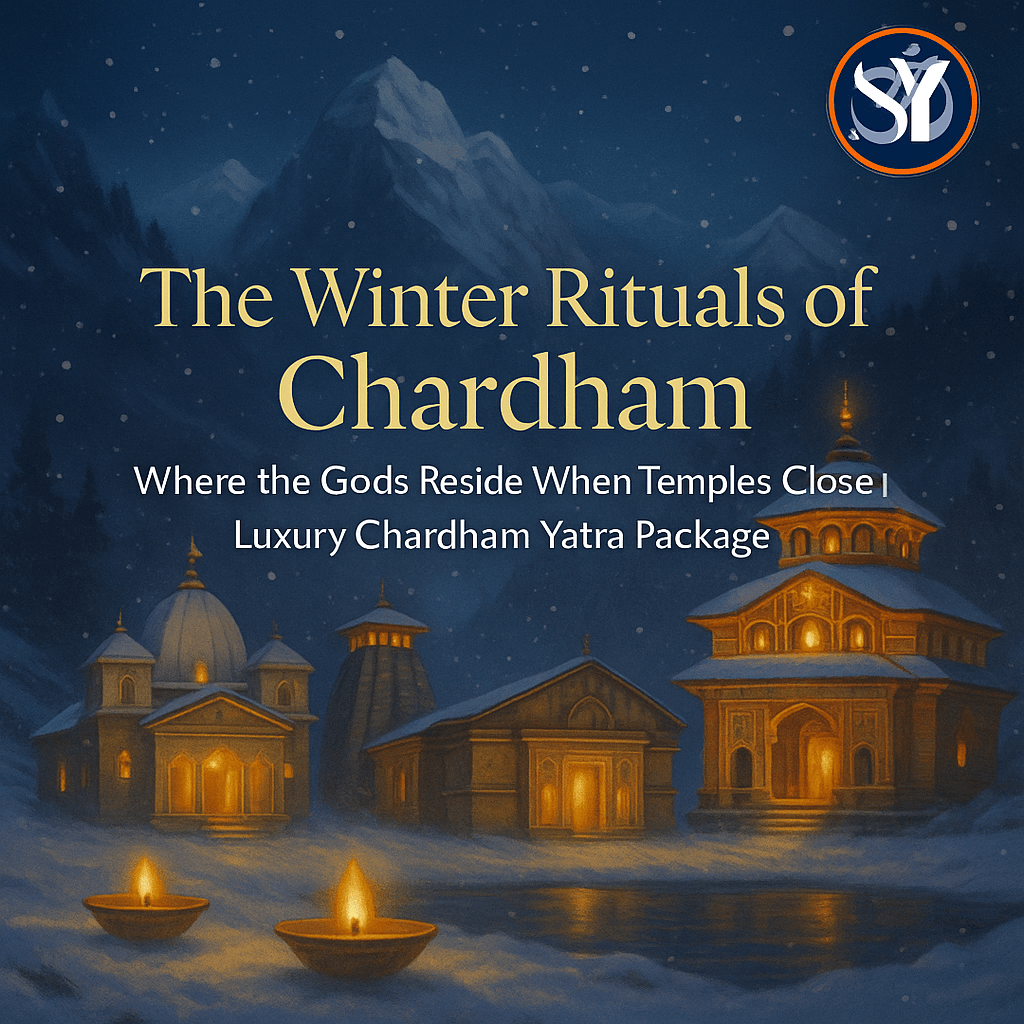
The Winter Rituals of Chardham: Where the Gods Reside When Temples Close | Luxury Chardham Yatra Package 2026-The holy Chardham Yatra—covering Yamunotri, Gangotri, Kedarnath, and Badrinath—is one of India’s most cherished pilgrimages, drawing millions of devotees every year. While the summer and monsoon months mark the main Yatra season, the winter months hold a sacred mystery of their own. When snow covers the Himalayan paths and the temples close for six long months, the deities do not disappear. Instead, divine winter rituals begin, and each deity is ceremoniously moved to their respective winter abodes, where worship continues uninterrupted.
For spiritual seekers planning a Luxury Chardham Yatra Package, understanding these winter traditions enriches the pilgrimage experience. Even though the temples close from October–November till April–May, the soul of Chardham remains alive through rituals, festivals, and age-old customs that have been preserved for centuries.
In this immersive guide, we explore where the gods reside in winter, the mythological significance behind these transitions, and how this knowledge deepens the spiritual essence of your journey.
Why Do Chardham Temples Close in Winter?
The Chardham shrines stand high in the Uttarakhand Himalayas:
- Yamunotri – 3,293 m
- Gangotri – 3,415 m
- Kedarnath – 3,583 m
- Badrinath – 3,300 m
During winter, these regions receive heavy snowfall, dropping temperatures below –10°C. Roads become inaccessible, rivers freeze, and villages close off for months. Because devotees cannot reach the shrines, the doors of the temples are ceremoniously shut with ancient rituals called Kapat Bandhan.
But the deities must continue receiving worship. And so begins the sacred winter migration.
Where the Gods Reside in Winter
Each Chardham deity has a winter seat (स्थान) where daily puja continues exactly as it is performed in the main shrine. These winter abodes are easier to reach and remain accessible even in peak winters.
Let’s explore each one.
🕉 1. Yamunotri Dham – Goddess Yamuna’s Winter Home: Kharsali Village
When Yamunotri Temple closes, Goddess Yamuna’s idol is carried to Kharsali, a beautiful village near Janki Chatti.
Winter Ritual Highlights
- The idol is decorated with flowers and ornaments.
- The palaki (palanquin) journey includes chanting of Yamuna stotras.
- Priests from the Uniyal family perform the daily rituals.
- Kharsali’s ancient Shani Temple also plays a special role in the ceremonies.
For those on a Luxury Chardham Yatra Package, visiting Kharsali in winter offers a serene and divine experience far from the summer crowds.
🌊 2. Gangotri Dham – Goddess Ganga’s Winter Seat: Mukhba Village
When Gangotri Temple closes, the idol of Mother Ganga is brought to Mukhba, located near Harsil.
Rituals & Significance
- The local villagers welcome the idol with traditional Himalayan music.
- The puja continues throughout winter in a beautifully decorated temple.
- Ganga aarti is performed daily, attracting devotees even during snow.
Mukhba’s warm hospitality and spiritual calm make it a precious halt in any Luxury Chardham Yatra Package.
🔱 3. Kedarnath Dham – Lord Shiva’s Winter Seat: Omkareshwar Temple, Ukhimath
Kedarnath, located in the Rudraprayag district, becomes inaccessible after heavy snowfall. The Panch-Kedar tradition says Lord Shiva must continue receiving worship, so his idol is carried to Ukhimath, where Omkareshwar Temple serves as the winter seat.
Spiritual Highlights
- The palaki journey is one of the grandest winter rituals.
- Priests of the Kedarnath lineage continue the puja routines.
- Local legends say the divine presence of Shiva never leaves Kedarnath; it simply becomes dormant under snow.
Ukhimath is a pilgrimage destination in itself and is easily included in a Luxury Chardham Yatra Package.
🔥 4. Badrinath Dham – Lord Vishnu’s Winter Home: Pandukeshwar (Narsimha Temple)
Among all Chardham temples, Badrinath is the most renowned. In winter, Lord Badri is moved to Pandukeshwar’s Narsimha Temple, located between Joshimath and Badrinath.
Rituals & Legends
- The idol of Vishnu travels in an elaborately decorated palaki.
- Narsimha Temple, a sacred place from Mahabharata times, becomes the main temple.
- A miracle occurs every year:
The right arm of the Narsimha idol reportedly becomes thinner as the closing season approaches, signaling snow in Badrinath.
These enchanting winter stories are what make the Luxury Chardham Yatra Package spiritually complete.
Why Understanding Winter Rituals Enhances Your Yatra
Most pilgrims only focus on the summer pilgrimage. However, the winter traditions reveal:
✔ The unbroken continuity of Himalayan worship
✔ Hidden stories preserved through generations
✔ Deep spiritual symbolism behind each temple’s closing
✔ The cultural resilience of mountain communities
When you embark on a Luxury Chardham Yatra Package, knowledge of winter rituals lets you appreciate not just the physical temples but also the eternal presence of the deities beyond seasons.
Divine Symbolism Behind the Winter Move
1. Nature’s command
Winter represents a time of rest. The shift of the deities symbolizes surrender to nature’s rhythm.
2. Eternal presence
The gods do not “leave.” Their energy simply transfers, maintaining the cosmic balance.
3. Every journey continues
Just as the Yatra moves from one temple to another, the deities also move—reminding us that life is dynamic and cyclical.
How Luxury Chardham Yatra Packages Enhance This Sacred Understanding
Premium pilgrimage packages elevate the overall experience through:
✨ 5-star stays in Haridwar, Guptkashi, Joshimath, and Dehradun
✨ VIP Darshan & crowd-free temple access
✨ Comfortable transportation (Innova/Tempo Traveller)
✨ Helicopter options for Kedarnath & Badrinath
✨ Skilled tour managers & spiritual guides
✨ In-depth storytelling about winter rituals
A Luxury Chardham Yatra Package is not just travel—it is a journey of devotion, comfort, and profound learning.
What Pilgrims Can Learn from the Winter Rituals
🕉 Faith continues beyond physical presence
Even when temples close, the worship remains unbroken—teaching devotees that God resides everywhere.
🕉 Nature governs divine rhythms
The Himalayas determine when the gods move, teaching humility before nature.
🕉 Sacred traditions are eternal
Generations have preserved these customs, making the Chardham Yatra a timeless spiritual experience.
Can You Visit the Winter Seats?
Yes! Many pilgrims today choose to visit:
- Kharsali (Yamuna Maa)
- Mukhba (Ganga Maa)
- Ukhimath (Shiva)
- Pandukeshwar (Vishnu)
These visits can be included in your Luxury Chardham Yatra Package, especially during early winter.
Conclusion: The Soul of Chardham Lives Beyond Seasons
The Winter Rituals of Chardham: Where the Gods Reside When Temples Close | Luxury Chardham Yatra Package-The winter rituals of Chardham are among the most beautiful, lesser-known traditions of India’s spiritual heritage. While snow forces the temples to close, the divine presence remains alive through rituals carried out in the winter abodes. Understanding these rituals gives deeper meaning to your journey when you undertake a Luxury Chardham Yatra Package, making your pilgrimage both emotionally and spiritually fulfilling. Su-Yatra Offers different Chardham Yatra Packages-
1-Chardham Yatra Package From Haridwar (9N/10D) | 2026